AI Referral Traffic Converts 4.4x Higher Than Organic, and Most Marketers Are Ignoring It
AI referral traffic is under 1% of total web visits but converts 4.4x higher than organic search. Here's why smart agencies are chasing citations, not clicks.
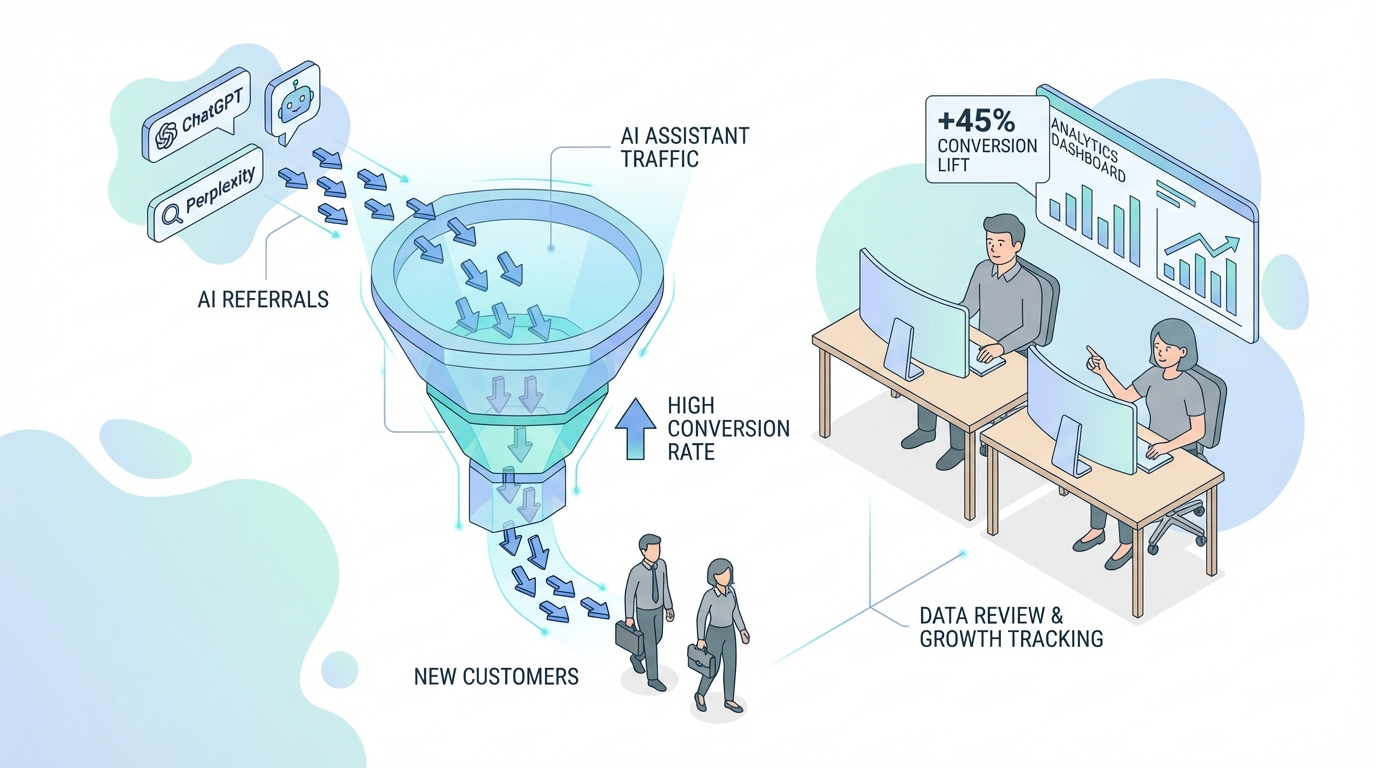
Google Search referrals to publishers dropped 34% over the past year. Small publishers got hit even harder, losing 60% of their Google traffic. Meanwhile, AI referral traffic accounts for just 1.08% of all website visits, according to Conductor’s 2026 benchmarks. If you stopped reading there, you’d think AI search is irrelevant. You’d be wrong.
Those AI-referred visitors convert at 4.4 times the rate of standard organic traffic. They spend 68% more time on-site. They don’t bounce. They buy, book, and submit forms at rates that make your best-performing landing pages look average.
This is the split that’s reshaping digital marketing right now: volume is collapsing in one channel while value is concentrating in another. The agencies and brands that recognize it are already reallocating budgets. The ones still staring at Google Analytics session counts are optimizing for a metric that means less every quarter.
The Volume Trap: Why Session Counts Are Misleading You
Most marketing dashboards still treat traffic volume as a primary health metric. More sessions equals better performance. Fewer sessions triggers a panic call.
That logic made sense when Google Search was the dominant source of qualified visitors. It doesn’t hold up when Google itself is keeping more users inside its own ecosystem through AI Overviews, AI Mode overlay cards, and Search Live, which went global across 200+ countries in March.
Chartbeat’s data, shared by Axios, paints the picture clearly. Over the past year:
- Small publishers (under 10,000 daily pageviews): 60% drop in Google referral traffic
- Medium publishers (10,000 to 100,000 daily): 47% drop
- Large publishers (100,000+ daily): 22% drop
Google Discover traffic fell 15% on top of that. Total traffic across all publishers dropped 6% between 2024 and 2025, and the first quarter of 2026 suggests the decline is accelerating.
Here’s what’s critical to understand: this isn’t a temporary dip caused by an algorithm update. Google’s March 2026 core update is still rolling out, but the traffic decline predates it. This is structural. Google is transitioning from a referral engine to an answer engine, and every feature it ships, from AI Overviews to AI Mode, reduces the number of clicks that leave Google’s domain.
If your reporting still equates “organic sessions” with “marketing performance,” you’re measuring the wrong thing.
What Makes AI Referral Traffic So Much More Valuable
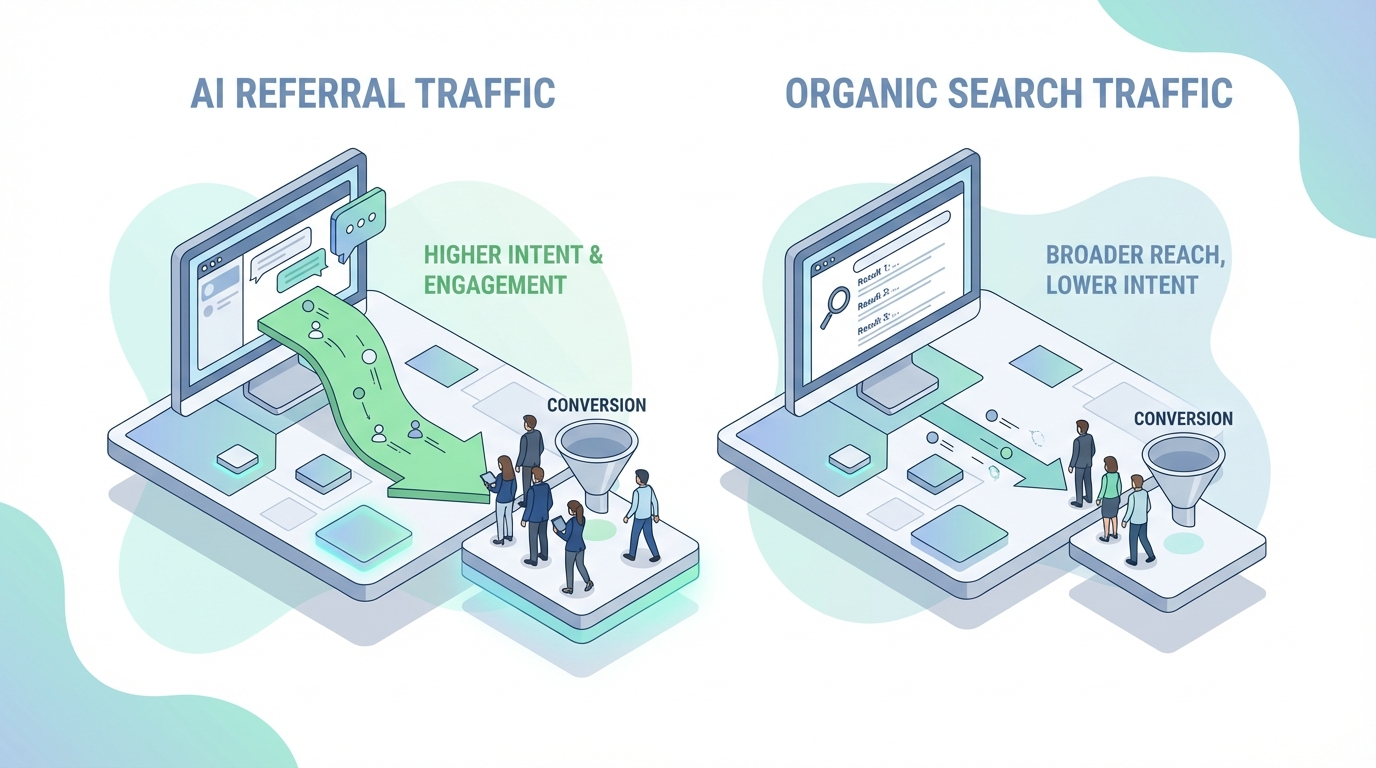
The 4.4x conversion rate isn’t a fluke. It’s a direct result of how AI search works compared to traditional search.
When someone types a query into Google, they get ten blue links. They click one. Maybe it’s relevant. Maybe they bounce in three seconds and try the next result. Traditional organic traffic has always included a huge volume of low-intent, quick-bounce visits that inflate session counts without generating revenue.
AI search works differently. When ChatGPT, Perplexity, or Gemini answers a question, it synthesizes information from multiple sources and presents a direct response. If that response includes a citation link to your website, the user clicking it has already:
- Received a recommendation. The AI didn’t just list your URL. It contextualized your content within its answer. The user knows what you offer before they arrive.
- Self-qualified their intent. They’re not clicking to discover whether you’re relevant. They’re clicking to go deeper on something the AI already confirmed is relevant.
- Developed trust before arrival. The AI functioned as a trusted advisor. Being cited by it carries implicit endorsement, similar to a referral from a colleague.
This is why AI-referred visitors spend 68% more time on-site than traditional organic visitors. They aren’t browsing. They’re investigating a recommendation they already trust.
For agencies reporting to clients, this reframes the entire conversation. A client who loses 30% of their organic sessions but gains AI citations that convert at 4.4x may actually be better off in revenue terms. The traffic number went down. The business outcome went up.
ChatGPT Drives 87.4% of AI Referral Traffic, and That Matters
Not all AI search engines are equal in referral behavior. Conductor’s 2026 benchmarks show ChatGPT driving 87.4% of all AI referral traffic to websites. Perplexity, Gemini, Claude, and others split the remaining 12.6%.
Why the dominance? Two factors:
Query volume. ChatGPT has over 400 million weekly active users. No other AI engine comes close. The sheer number of conversations creates proportionally more citation opportunities.
Citation behavior. ChatGPT consistently includes clickable source links in its responses. Other engines vary: Perplexity includes them reliably, Gemini less consistently, and Google’s AI Overviews have historically buried source links below the fold. ChatGPT puts citations where users can find and click them.
The practical takeaway for agencies: if you’re building an AEO strategy and you’re not specifically optimizing for ChatGPT’s citation patterns, you’re optimizing for the long tail while ignoring the channel that drives nearly nine out of ten AI-referred visits.
This doesn’t mean you should ignore Perplexity or Gemini. But resource allocation should reflect the data. ChatGPT citation optimization deserves the largest share of your AEO effort.
How to Track AI Referral Traffic (Most Teams Are Missing It)
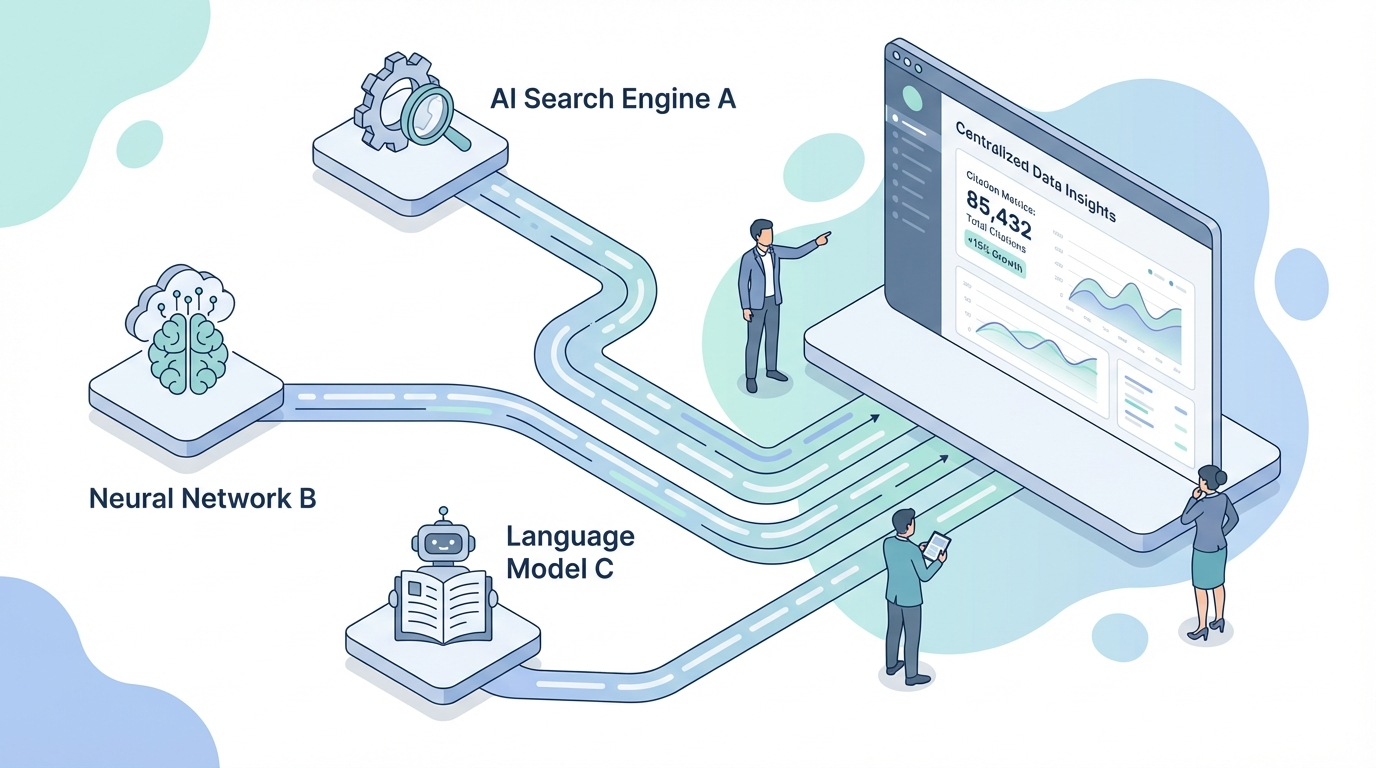
One of the biggest problems with AI referral traffic today is that most analytics setups aren’t configured to track it properly. GA4 doesn’t automatically segment AI-referred visits into a clean channel. Much of it lands in “direct” or “other” because the referral headers from AI engines aren’t always clean.
Here’s how to set up proper tracking:
Step 1: Create referral source segments. In GA4, build custom channel groupings that isolate traffic from chatgpt.com, perplexity.ai, copilot.microsoft.com, and gemini.google.com. These are your primary AI referral sources.
Step 2: Monitor dark traffic. A significant portion of AI-referred visits arrive with no referral header at all. The Digital Bloom’s February 2026 traffic report found that ChatGPT accounts for 64.5% of identifiable AI traffic, with Gemini at 21.5%. But a substantial chunk of AI traffic shows up as “direct” in analytics because the AI engine strips the referral header on handoff. If your direct traffic is growing while organic is falling, some of that growth is likely AI referrals.
Step 3: Track conversion events per source. Don’t just count sessions. Track form submissions, purchases, calls, and chat initiations segmented by AI referral source. This is where the 4.4x conversion data becomes actionable for your specific business.
Step 4: Build a citation monitoring habit. Use tools like Emarketed’s AI Search Optimizer to check whether your key pages are being cited across ChatGPT, Perplexity, and Google AI Overviews. Citation presence is the leading indicator. Referral traffic is the lagging indicator.
The Agency Reporting Shift This Demands
If you run an agency, this data forces a reporting conversation with clients that many teams aren’t ready for.
The old report: “Organic sessions increased 12% month-over-month. Here’s your keyword ranking chart.”
The new report: “Organic sessions declined 8%, consistent with the industry-wide Google referral drop. However, AI referral traffic increased 23%, and those visitors converted at 3.8x the rate of organic. Net revenue impact: positive.”
That second report requires more sophisticated tracking, more context-setting with clients, and a willingness to explain that the rules have changed. It also requires proof. You need the GA4 segments, the conversion data, and the citation tracking to back it up.
Agencies that can deliver this report will retain clients through the traffic decline. Agencies that keep sending session-count reports will lose clients who see the numbers dropping and blame their agency.
We’ve seen this firsthand. Seasons in Malibu holds 4,200+ keyword rankings. Their organic traffic has declined as AI Overviews absorb clicks on queries where they already rank. But their AI mentions grew from 49 to 122, a 149% increase. The business outcome, actual patient admissions, hasn’t suffered because the visitors arriving through AI citations are higher-intent than the ones lost to zero-click results.
That’s the story agencies need to be telling: traffic composition matters more than traffic volume.
What Content Gets Cited by AI (and What Gets Ignored)
Not all content earns AI citations equally. If you want to capture the high-converting traffic AI search sends, your content needs to match what language models look for when selecting sources.
Direct, specific answers. AI engines cite content that directly answers the question a user asked. If your blog post buries the answer beneath four paragraphs of context-setting, it won’t get cited. Lead with the answer.
Data and original research. Content with specific numbers, original statistics, and named methodologies gets cited more frequently than opinion pieces or general overviews. If you can publish survey data, case study results, or proprietary benchmarks, you become a primary source that AI engines treat as citable.
Structured formatting. Clear H2 headers, bullet lists, FAQ sections, and table formats make it easier for AI engines to extract and attribute specific claims. Think of your content structure as an API for language models.
Authority signals. Named authors with credentials, “about” pages that establish expertise, citations of your content by other authoritative sources, and consistent publication history all feed into the trust signals AI engines use to decide whether to cite you.
Freshness. AI engines increasingly weight recency. A well-structured page published this month will often outperform a better-written page from 2024 on the same topic. Keep your high-value pages updated.
The brands getting cited consistently aren’t necessarily the ones with the most content. They’re the ones with the most citable content: specific, structured, authoritative, and current.
The Budget Reallocation Most Teams Need to Make
Forbes Agency Council reported that AI-driven traffic is growing 165 times faster than organic search. That growth rate, combined with the 4.4x conversion premium, creates a clear case for budget reallocation.
Here’s a practical framework:
Audit your current split. Most marketing teams allocate 70-80% of their organic effort to traditional SEO: keyword research, backlink building, technical optimization. AEO and AI citation work gets 10-20% at best, often less.
Shift to a 50/30/20 model. Allocate 50% of organic effort to content that serves both traditional SEO and AI citation. Allocate 30% specifically to AEO activities: citation monitoring, structured content optimization, AI-specific schema markup, and platform-specific optimization. Reserve 20% for pure technical SEO and infrastructure.
Measure differently. Add “AI citation count” and “AI referral conversion rate” to your monthly KPIs alongside traditional metrics. Within two quarters, you’ll have enough data to further refine the allocation based on what’s actually driving revenue.
Don’t abandon SEO. This isn’t an either/or. Traditional rankings still drive traffic, and that traffic still converts. The shift is about proportional investment matching proportional return, and right now, the return on AI citation optimization is disproportionately high relative to what most teams invest.
FAQ
How much of total web traffic comes from AI search engines?
AI referral traffic currently accounts for approximately 1.08% of all website traffic, according to Conductor’s 2026 benchmarks. While the percentage is small, it’s growing roughly 1% month-over-month, and ChatGPT referrals grew over 200% through 2025.
Why does AI referral traffic convert so much higher than organic?
Visitors from AI search engines arrive pre-qualified. The AI has already recommended your brand or content within its response, functioning as a trusted advisor. Users clicking through are investigating a recommendation, not browsing search results. This intent difference drives the 4.4x conversion premium.
Which AI search engine sends the most referral traffic?
ChatGPT drives 87.4% of all AI referral traffic to websites, according to Conductor’s data. Perplexity, Gemini, and other AI engines split the remaining 12.6%. ChatGPT’s dominance comes from its 400 million+ weekly active users combined with its consistent citation behavior.
How do I track AI referral traffic in GA4?
Create custom channel groupings that isolate traffic from chatgpt.com, perplexity.ai, copilot.microsoft.com, and gemini.google.com. Also monitor your “direct” traffic segment, as some AI referrals arrive without clean referral headers and get miscategorized.
Should agencies stop reporting on organic traffic?
No. Organic traffic remains a significant channel. But agencies need to contextualize it within the broader trend of declining Google referrals and pair it with AI citation metrics and AI referral conversion data. A client losing organic sessions but gaining high-converting AI referral traffic may be in a stronger position than the session count suggests.
How do I get my content cited by AI search engines?
Focus on direct answers, original data, structured formatting (clear H2s, bullet lists, FAQs), strong authority signals, and content freshness. AI engines cite sources that directly and specifically answer user questions with verifiable information.
What to Do This Week
Stop looking at your traffic dashboard and feeling anxious about the session count. Open GA4, build the AI referral segments described above, and run a conversion comparison against your organic traffic. If you see the same 3x to 5x conversion premium that the industry data suggests, you have your answer about where incremental budget should go.
Then audit your top 20 pages for AI citability. Are they structured for extraction? Do they lead with direct answers? Do they include specific data points? If not, that’s your content sprint for April.
The brands winning in AI search right now aren’t the ones with the most traffic. They’re the ones whose traffic actually converts. Every week you wait to build an AI search optimization strategy is a week your competitors use to become the brands these models recommend instead of you.