AI Marketing Agents for Social Media: Tools, Strategies, and Results
What to automate, what to keep human, and which tools to use.
How to use AI marketing agents to manage your social media without losing the human personality that makes your brand worth following.
Social media is the marketing channel that never sleeps. There is always another post to write, another comment to respond to, another trend to consider, and another algorithm change to adjust for. For small businesses, it is one of the biggest time sinks in the entire marketing operation.
AI marketing agents are well-suited to help here because social media rewards two things that AI is good at: consistency and data-driven optimization. But social media also rewards something AI is not great at: genuine human personality. Getting the balance right is what separates brands that grow on social from brands that feel like they are on autopilot.
This article covers the practical side of using AI agents for social media, including which tools work best, strategies that produce real results, and honest guidance on what to automate and what to keep human.
This article is part of our Ultimate Guide to AI Marketing Agents for Small Businesses, your complete resource for AI-powered marketing strategy and implementation.
What AI Agents Can Actually Do for Your Social Media
Let us be specific about the tasks where AI adds the most value:
Content generation and ideation. AI can produce draft posts, suggest content themes based on trending topics in your industry, and create multiple variations of a single idea for testing across platforms. This eliminates the “staring at a blank screen” problem that slows down most small business social media efforts.
Scheduling and timing optimization. AI analyzes when your audience is most active and schedules posts accordingly. Instead of guessing that 9am on Tuesday is a good time to post, the agent looks at your actual engagement data and optimizes send times for each platform individually.
Hashtag and keyword research. The agent identifies which hashtags and keywords are driving engagement in your space and suggests relevant ones for each post. This saves you from manually researching trending tags every time you publish.
Performance analytics. AI tracks which types of content perform best, which platforms drive the most engagement, and where your follower growth is coming from. It surfaces patterns that would take you hours of manual analysis to uncover.
Competitor monitoring. Some AI tools track what your competitors are posting, how their content performs, and which strategies seem to be working for them. This competitive intelligence helps you spot opportunities and avoid repeating what is not working for others.
Automated responses to common inquiries. AI chatbots and auto-responders can handle frequently asked questions in DMs and comments, like business hours, pricing, and shipping information. This keeps response times fast without requiring you to check your phone every ten minutes.
What to Keep Human
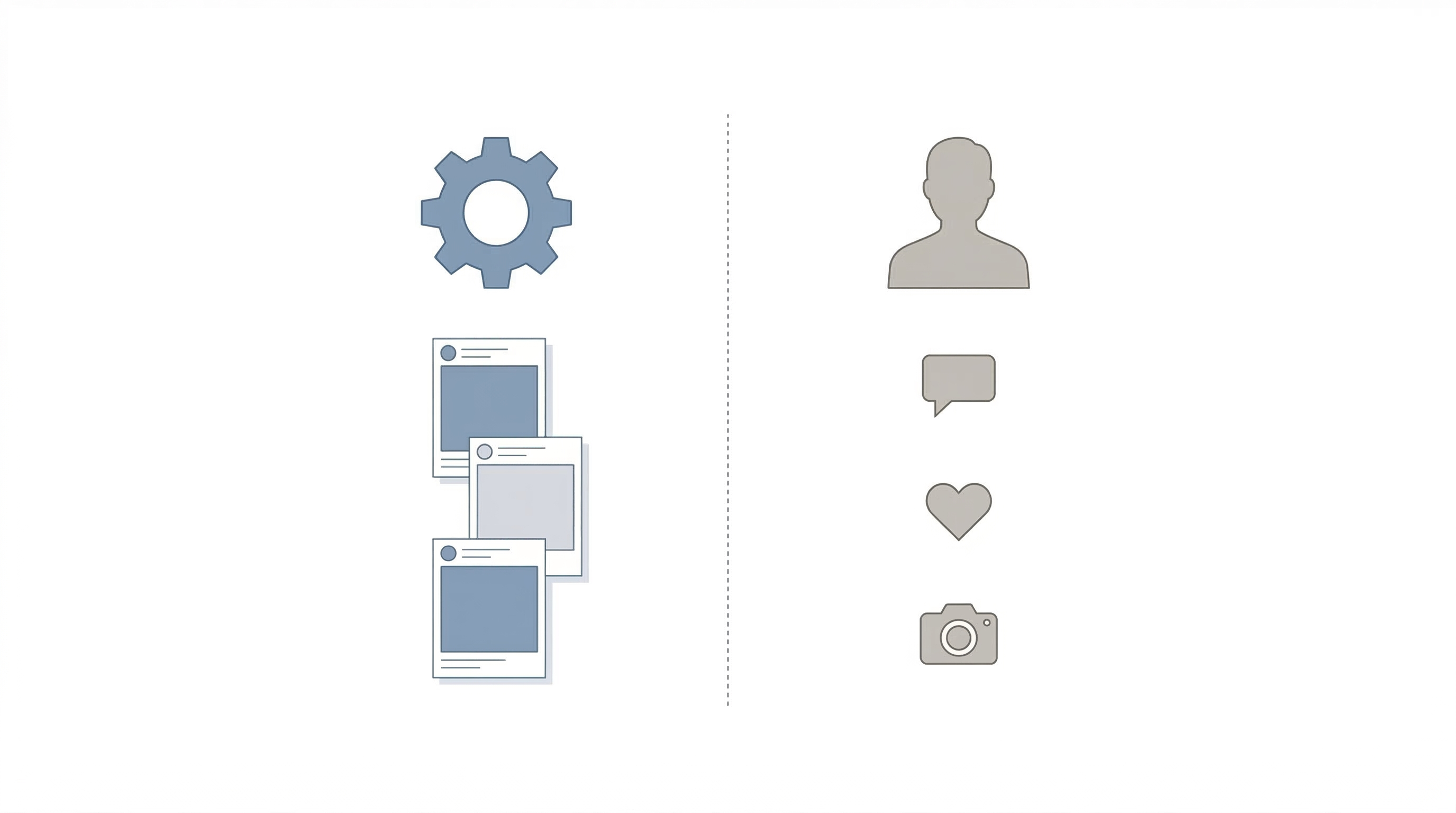
This list is just as important as the one above:
Replies to genuine comments and conversations. When someone takes the time to leave a thoughtful comment or ask a real question, they deserve a real response. AI-generated replies in these moments feel hollow and customers can tell.
Stories and behind-the-scenes content. The content that builds the deepest connection with your audience is the stuff that feels spontaneous and personal. A quick video of your team packing orders or a candid photo from an event carries more weight than a perfectly polished AI-generated graphic.
Crisis or sensitive responses. If a customer posts a complaint publicly, or if a sensitive event happens in your community, a human needs to handle the response. AI does not read emotional context well enough for these situations.
Community building. Engaging with other accounts, joining conversations in your niche, and building relationships with complementary businesses requires genuine human interaction. AI can monitor these opportunities, but a person should act on them.
Brand personality. Your unique voice, humor, perspective, and quirks are what make people follow you instead of your competitor. AI can maintain consistency, but it cannot originate personality. That comes from you.
Tools Worth Looking At
Here is a practical breakdown of AI social media tools that work well for small businesses:
Sprout Social AI. Strong analytics and scheduling with AI-powered suggestions for optimal posting times and content types. The social listening features are particularly useful for tracking brand mentions and industry conversations. Higher price point but comprehensive.
Lately AI. Takes your long-form content (blog posts, podcasts, webinars) and automatically generates dozens of social media posts from it. Good for businesses that produce content in other formats and want to repurpose it efficiently.
Buffer with AI Assistant. Buffer’s AI helps generate post ideas and captions directly within their scheduling interface. It is simpler than enterprise tools but hits the right balance of capability and ease of use for small businesses.
Predis.ai. Generates both organic social content and ad creative from a single brief. The competitor analysis feature shows you what similar businesses are doing. Affordable entry point for solopreneurs.
ManyChat. Focused specifically on messaging automation across Instagram DMs, Facebook Messenger, WhatsApp, and SMS. Excellent for businesses that generate leads and sales through direct messages.
The right choice depends on your primary platform, your budget, and whether you need content creation, scheduling, analytics, or all three. Most of these offer free trials, so test before you commit.
A Strategy That Actually Works

Here is a practical social media strategy using AI agents that we have seen produce consistent results for small businesses:
Step 1: Batch your content creation. Once a week, sit down for 30 to 45 minutes and use your AI tool to generate a week’s worth of post drafts. Review each one, edit for voice and accuracy, and schedule them.
Step 2: Let AI handle the analytics. Instead of manually checking your metrics, set up your AI tool to send you a weekly performance summary. Review it in five minutes and note which content types and topics performed best.
Step 3: Show up personally 15 minutes a day. Spend a short block each day responding to comments, engaging with other accounts, and posting one piece of spontaneous content (a story, a quick thought, a behind-the-scenes moment). This is the human layer that AI cannot replace.
Step 4: Use AI to repurpose your best performers. When a post does well, use the AI to create variations of it for other platforms or future use. One strong idea can become five or six pieces of content across different formats and channels.
Step 5: Review and adjust monthly. Once a month, look at the broader trends. Which platforms are growing? Which content themes are resonating? What should you do more of, and what should you stop? Use the AI’s data to make these decisions instead of guessing.
This approach keeps your total social media time to roughly 4 to 5 hours per week while producing more consistent output than most small businesses achieve with double that time investment.
Realistic Results to Expect
Setting honest expectations matters. Here is what we typically see when small businesses implement AI for social media:
Month 1: Posting consistency improves significantly. Engagement may stay flat or increase slightly as the audience adjusts to more frequent content. This is the setup and calibration phase.
Month 2: The AI starts identifying what works for your specific audience. Content quality improves as you refine the AI’s understanding of your brand voice. Engagement begins trending upward.
Month 3 and beyond: Compounding effect kicks in. Better content posted at better times to a growing audience produces steadily improving results. Most businesses see 20 to 40% increases in engagement metrics by the end of the third month.
Social media growth is inherently slower than other marketing channels. Do not expect the dramatic revenue jumps you might see from email or paid advertising. The value of social media is brand building, community, and long-term visibility, and AI agents make it possible to sustain that effort without burning out.
For guidance on combining social media with other AI-powered channels, read How to Implement an AI Marketing Agent in Your Small Business. And for more on the human side of the equation, see AI Marketing Agents vs. Human Marketers: A Detailed Comparison.
Need help building an AI-powered social media strategy? Talk to the Emarketed team about a plan that fits your business and budget.