AI Search Trust Is Now A Conversion Problem
AI search usage is climbing fast, but trust is fragile. Here is how brands can turn citations, proof, and page structure into real conversion lift.

AI search is no longer an early-adopter behavior. It is normal behavior, and that changes what marketers have to optimize for.
Pew Research Center’s June 17, 2026 report found that 49% of U.S. adults now use AI chatbots, up from 33% in 2024. It also found that 42% use chatbots to search for information, while a separate Pew chart published June 17, 2026 shows 60% of U.S. adults say they read AI summaries at the top of search results. That is the adoption story. The trust story is rougher: the same Pew report says Americans tilt negative on AI’s impact, majorities think AI is advancing too quickly, and many expect weaker privacy and information quality.
That combination matters more than another traffic chart. If AI search is mainstream but users are skeptical, your website has a new job: it has to confirm, sharpen, and de-risk whatever the AI just said about you.
This is where a lot of brands still miss the plot. They celebrate an AI mention, or panic about lost clicks, while ignoring the real business question: what happens after the mention? If the buyer lands on a vague page, a thin service description, or a trust-light website, the AI mention did not create demand. It just delivered a skeptical visitor faster.
For agencies, healthcare marketers, and high-consideration service brands, that makes trust architecture a conversion issue, not just an SEO issue.
AI Search Adoption Is Moving Faster Than Brand Trust
The latest Pew numbers are large enough to end the “maybe later” conversation.
About half of U.S. adults now use AI chatbots. Search is the most common use case. Six in 10 say they read AI summaries in search results. Those are not niche habits anymore. They are mainstream discovery behaviors happening before a brand gets the click, the form fill, or the phone call.
At the same time, users are not blindly accepting what these systems say. Pew reports that Americans are broadly skeptical about AI’s impact and speed. That skepticism is not a footnote for marketers. It means AI answers do not finish the sale. They shift more evaluation work upstream.
That is the key strategic change. In the old search model, the result page mostly decided who got the visit. In AI search, the answer layer shapes the shortlist, but the site still has to win the trust check.
For a rehab center, that trust check might be insurance clarity, clinician credentials, privacy expectations, and proof that treatment claims are grounded in something real. For a B2B company, it might be implementation detail, category fit, procurement confidence, and whether the company sounds concrete or inflated. For a local service brand, it might be pricing logic, service area specificity, reviews, and process clarity.
In every case, the conversion path starts earlier than it used to and gets judged harder than it used to.

Why Generic AI Content Backfires Faster Now
Marketers are still tempted to respond to AI search with volume. More FAQs. More listicles. More “ultimate guides.” More category pages that all say the same thing in slightly different order.
That is getting less defensible by the week.
In a June 18, 2026 Search Engine Land report on Lily Ray’s analysis, Google AI Overviews cited self-promotional listicles while excluding the brands behind them from recommendations in 69% of cases. That is a brutal outcome for brands trying to game recommendations with “best of” pages about themselves. The system may use your page as source material and still send the commercial value elsewhere.
One day earlier, Search Engine Land argued in “What replaces the ultimate guide in AI search” that the old 4,000-word guide format is no longer the safe default for visibility. The more citable structure is tighter: explicit entities, direct claims, real conditions, and content that can be lifted without losing meaning.
That lines up with what smart teams are seeing in live prompts. AI systems do not reward generic padding well. They reward content that is easy to interpret, easy to verify, and easy to connect to a known entity.
This is one reason digital PR matters more in AI search. If your site makes strong claims but the rest of the web does not reinforce them, the answer layer has less reason to trust you. If your site is structurally clean but commercially self-serving, you may still get cited without becoming the recommendation.
So the goal is not “write more AI content.” The goal is to publish source-worthy content and then support it with enough external and on-site evidence that the brand feels safe to recommend.
The New Conversion Funnel Starts With Confirmation
A lot of websites were built for discovery and persuasion. They were not built for confirmation.
That distinction matters now.
When a buyer arrives from an AI answer, they often come in with three silent questions already loaded:
- Is this company actually what the AI said it is?
- Can I trust the claim enough to keep going?
- Is there enough specific proof here to reduce my risk?
Most sites answer those questions badly. They open with broad positioning language, generic hero copy, and thin social proof. That was weak even before AI search. It is worse now because the visitor has already seen a summarized version of your brand and is actively checking whether the summary holds up.
This is why answer engine optimization services should not stop at citation tracking. The real work is connecting AI visibility to page architecture, message clarity, and conversion support.
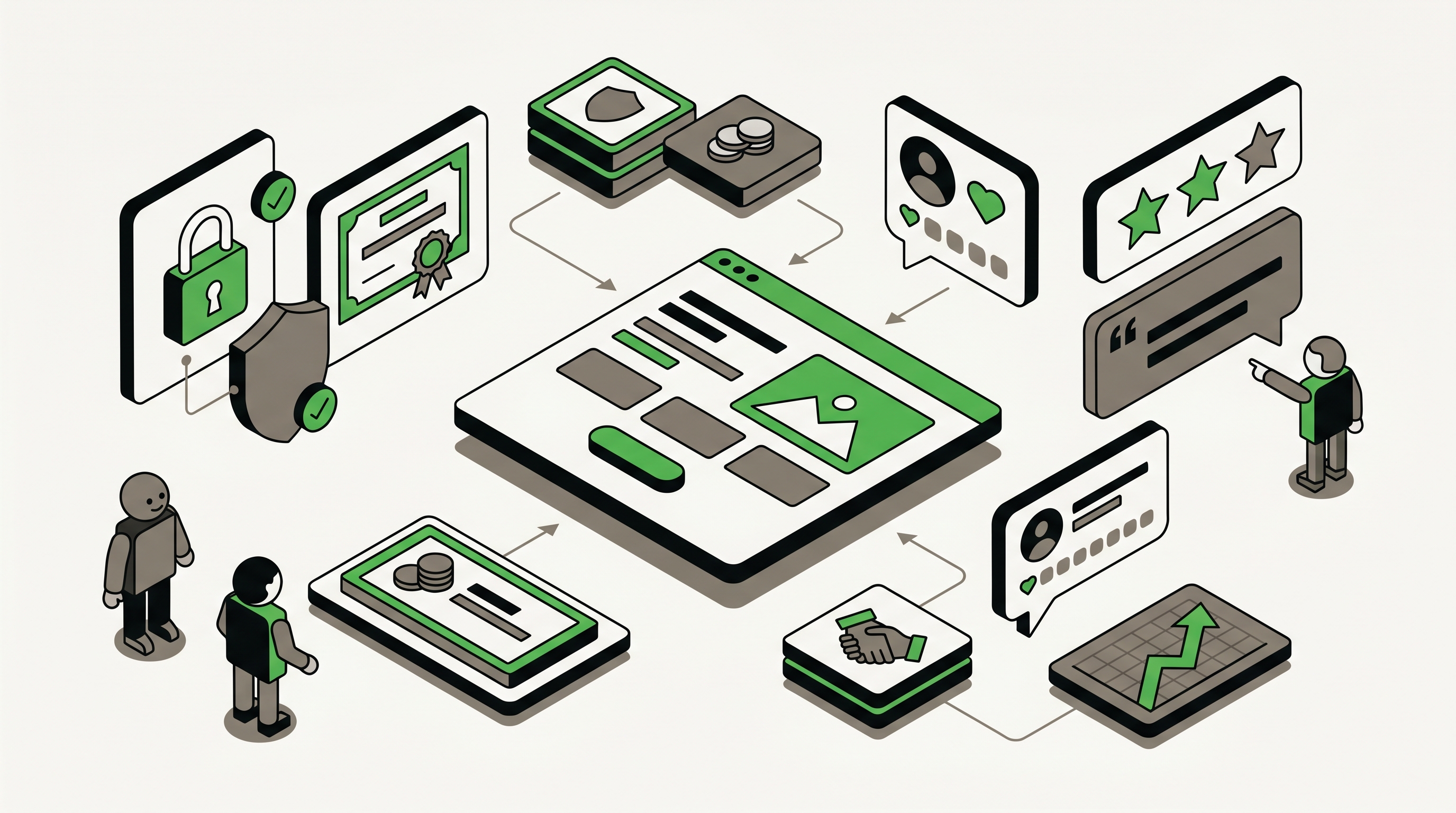
Pages that convert better in the AI era tend to do five things well:
- They answer the core claim in the first screen instead of hiding it under marketing filler.
- They show proof close to the claim, not twenty scrolls later.
- They make service fit obvious, including who the offer is for and who it is not for.
- They reduce ambiguity around process, timing, pricing logic, credentials, or outcomes.
- They reinforce trust with consistent language across bios, reviews, case examples, and supporting pages.
That is not a copywriting style preference. It is the new conversion layer.
What High-Trust Industries Should Fix First
Healthcare, behavioral health, legal, financial, and B2B service brands should move first because trust is already part of the product.
If someone asks an AI assistant about addiction treatment, pricing, safety, or care options, they are not looking for a clever content experience. They are looking for confidence. The same is true for a manufacturing buyer researching a vendor shortlist or a local business owner comparing agencies.
At Emarketed, we have seen this directly in healthcare. Seasons in Malibu increased AI mentions from 49 to 122 while cited pages rose from 122 to 190. The account also holds 4,200+ keyword rankings and 814,230 social impressions in a recent month. That matters because it shows what happens when trust signals are not isolated on one page. They stack across SEO, AEO, paid search, social, and the website itself.
For healthcare brands especially, I would prioritize four fixes before publishing another generic awareness article:
Build Proof Pages, Not Just Service Pages
Service pages explain what you offer. Proof pages explain why someone should believe you. That includes credentials, insurance guidance, treatment philosophy, real FAQs, process detail, and trust markers that reduce fear.
Tighten Your First Screen
If the first screen does not confirm the AI summary quickly, the visitor starts second-guessing both the answer and the brand. Say what you do, who you help, and what makes the offer credible immediately.
Turn Objections Into Structured Answers
If buyers repeatedly ask about cost, fit, privacy, timelines, safety, or comparisons, those answers belong on the site in clean, direct sections. This is especially important for healthcare teams trying to close the trust gap described in this Emarketed healthcare visibility guide.
Align Third-Party Signals With On-Site Claims
Your site should not be the only place asserting your authority. Reviews, citations, author pages, external mentions, and branded search results should reinforce the same reality.
What To Measure If You Want Revenue, Not Vanity
The AI search reporting conversation is still too obsessed with mentions alone.
Mentions matter. Citations matter. Share of model matters. But if the business goal is pipeline, the measurement layer has to go one step further.
Track these together:
- AI mention or citation presence on priority prompts
- Landing-page engagement from AI-referred traffic when you can isolate it
- Conversion rate on pages most likely to receive AI-primed visitors
- Assisted conversions where AI visitors come back later through branded search, direct, or retargeting
- Accuracy of brand descriptions across AI systems
This is where many teams learn the uncomfortable truth. A page can be visible in AI search and still underperform commercially because it does not reassure the visitor enough to move them forward.
That is not a reason to dismiss AEO. It is a reason to connect AEO to CRO.
The smartest brands in the next 12 months will not treat AI search as a top-of-funnel science project. They will treat it as the front end of a trust-sensitive conversion system.
What To Do Monday Morning
Pull five pages that matter to revenue. Then test them with one simple lens: if an AI assistant recommended this brand and sent a cautious buyer here, would this page make the recommendation feel safer or shakier?
Look at the hero copy. Look at the subheads. Look at whether proof sits next to claims. Look at whether key objections are answered clearly. Look at whether the page sounds like a real operator or like every other marketing site in the category.
Then pick one page and rewrite it for confirmation, not just discovery.
That usually means less filler, tighter claims, better FAQs, clearer fit language, stronger proof blocks, and fewer places where the visitor has to guess what you mean.
AI search has already changed how people discover brands. The next shift is which brands hold up when users go looking for reassurance. The winners will not be the loudest. They will be the easiest to trust.
FAQ
Why Is AI Search Trust A Conversion Problem Instead Of Just An SEO Problem?
Because the user often arrives with a pre-framed impression from an AI answer. If the landing page does not confirm that impression with specific proof, clarity, and trust signals, the visit stalls even if the citation itself was strong.
Are AI Mentions Still Valuable If They Do Not Send Many Clicks?
Yes, but only if they influence the shortlist or assist a later conversion path. Visibility without trust support can create awareness without commercial lift.
What Type Of Content Performs Better Than Generic Ultimate Guides?
Content that states clear claims, names real entities, preserves nuance, and answers decision questions directly. AI systems can cite that more reliably, and buyers can validate it faster.
How Can Healthcare Marketers Use This Without Sounding Promotional?
Lead with patient or family decision needs, not brand slogans. Answer real trust questions around fit, safety, insurance, process, and credentials with plain language and verifiable detail.
What Should Be Audited First On An Existing Site?
Start with service pages, proof pages, FAQs, clinician or leadership bios, review visibility, and any page that receives high-intent traffic from branded search or AI referrals.