AI Agents Have An Operations Problem, Not Just A Model Problem
AI agents can move fast, but the real business value depends on queues, review gates, observability, maintenance, and operating rules.
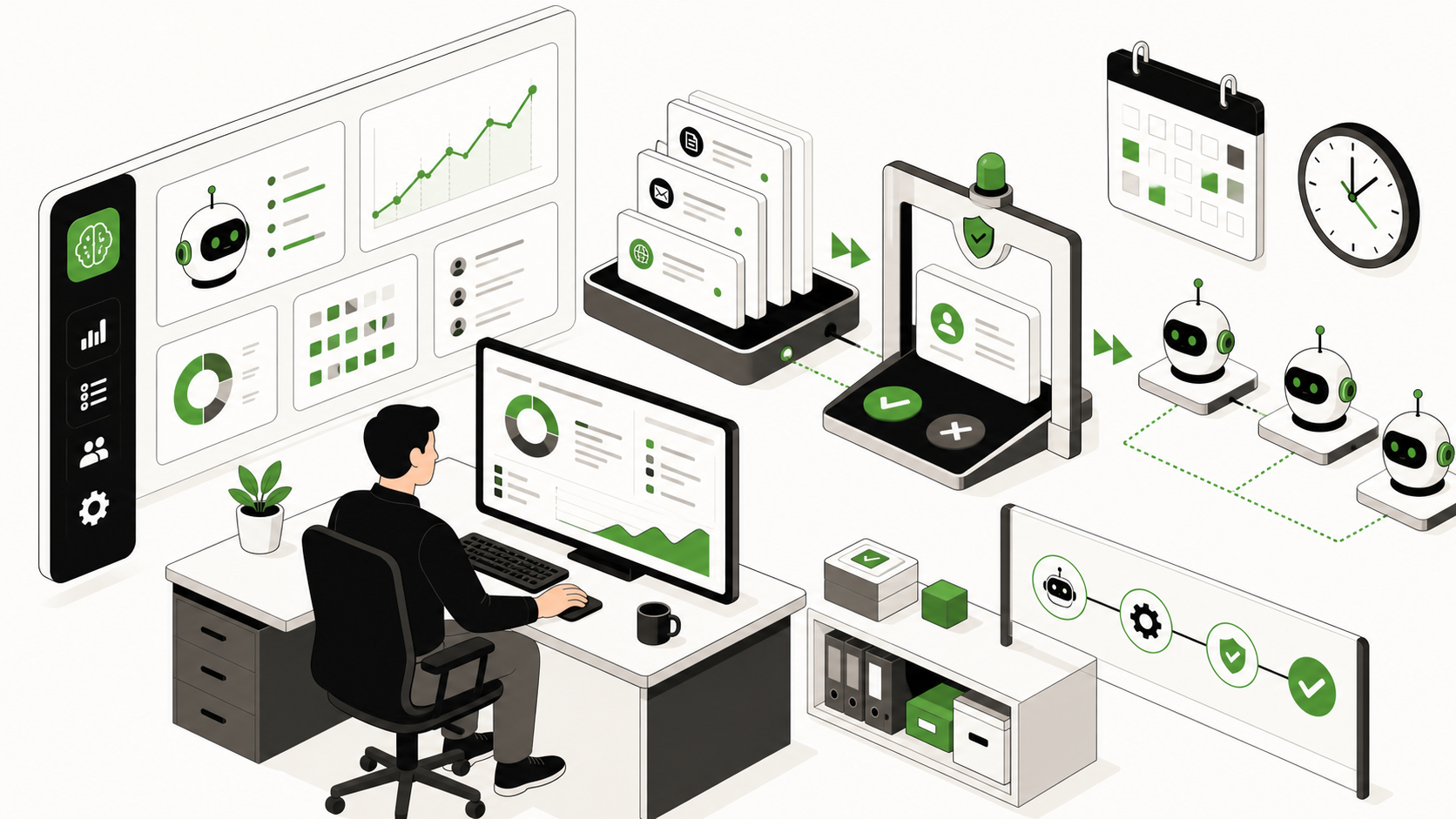
AI agents are moving from demos into real business workflows, and that is where the story gets more interesting.
The demo version is easy to love. An agent researches a topic, writes a draft, checks a CRM, summarizes a meeting, files a report, or builds a prospect list while a human does something else. The speed feels obvious. The cost savings look obvious. The pitch usually sounds like this: automate the repetitive work, free up the team, and let humans focus on strategy.
That can be true. We use agents at Emarketed every day for content operations, research, lead workflows, reporting checks, image generation, audio recap work, and internal monitoring. They absolutely help.
But the part that gets undersold is the operating layer. Agents do not simply remove work. They move work into a new category: scheduling, supervision, context maintenance, error recovery, logging, review, and policy design.
In other words, the agent problem is not just a model problem. It is an operations problem.
That distinction matters for any business looking at AI marketing agents in 2026. The question is no longer, “Can an agent do this once?” The better question is, “Can this agent keep doing the right thing, at the right time, with the right checks, as the business changes?”
The Demo Math Is Not The Real Math
A recent wave of articles has been circling the same point from different angles: agent ROI often looks better in a controlled demo than it does in production.
The AI Journal summarized the tradeoff clearly: agents can complete tasks much faster and at much lower direct cost, but their success rates can lag human workflows, especially when the task involves ambiguity, judgment, or external systems. That changes the calculation. A cheap task is not cheap if a person has to review every output, repair bad assumptions, and check whether the agent invented a missing detail.
Computerworld reported that employees are spending 6.4 hours a week “botsitting” AI systems. That is not a small rounding error. It is a meaningful part of a workweek. The same piece also points to a more uncomfortable behavior: overwhelmed employees shipping AI-assisted work they have not fully verified.
That is the danger zone. If the company treats AI as magic, the human reviewer becomes the safety system by default. Nobody budgets for that. Nobody scopes it. Nobody names it. But the work still happens.
At Emarketed, we see the same pattern in a practical way. A blog agent is not just a writer. It has to pick a topic, avoid duplicate coverage, follow brand rules, generate images, check links, update the valid URL reference, commit files, push to GitHub, wait for deploy, verify the live page, and notify the right channel. If any one of those steps is missing, the post is not really published.
The agent can write the article. The operation is everything around the article.
Agents Do Not Understand Business Hours Unless You Teach Them
Tian Pan’s piece, Your Agent Has No Concept of Business Hours, is one of the cleanest explanations of this problem. His point is not that the agent fails because it is dumb. The problem is that it may do exactly what you asked at the wrong time.
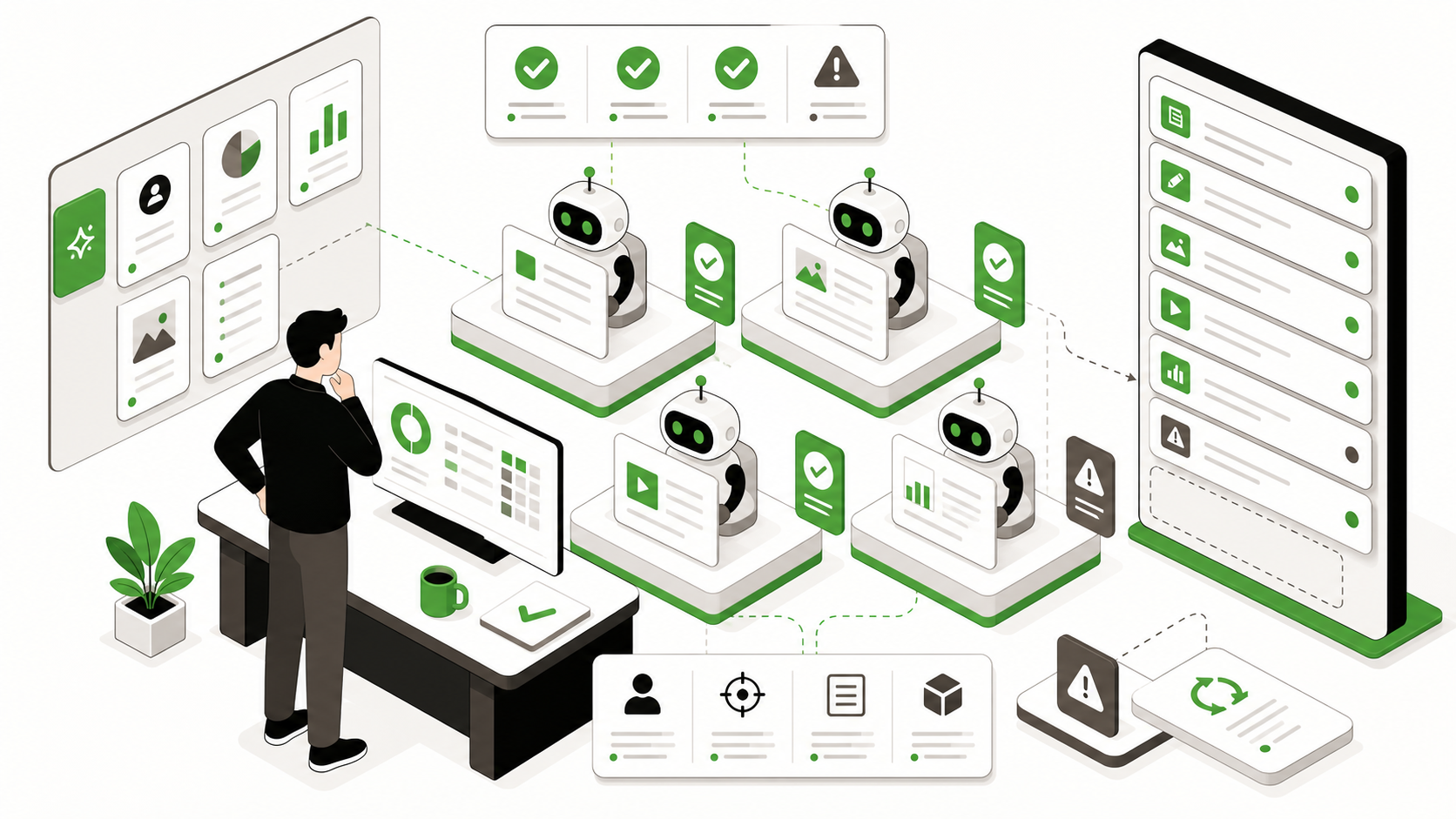
He draws a useful line between work that can happen anytime and work that should wait for daylight.
Anytime work includes internal computation, research, summarization, data cleanup, draft preparation, and report generation. If the agent wakes up at 3 a.m. to prepare a brief, that is fine.
Daylight work is different. Anything that touches a customer, employee, vendor, prospect, patient, reviewer, or public channel needs a queue, a schedule, or an approval gate. A refund notice, sales email, client Slack message, social post, or CRM-triggered outreach is not just an output. It is a human-facing business action.
This is where many teams get agent automation wrong. They define the task but not the timing policy.
“Act now” is not a strategy. It is usually the absence of a strategy.
For marketing teams, this shows up everywhere:
- An agent drafts a lead follow-up at midnight and sends it immediately
- A social agent posts before the image is checked
- A reporting agent sends a client recap before the data is reconciled
- A content agent updates a live page without a redirect check
- A support agent escalates a vague case to the wrong person
None of those failures require hallucination. The agent may be following instructions. The missing piece is the operating rule.
That is why we think every agent workflow needs two lanes from the beginning: internal work that can run whenever, and external work that waits for the right time, channel, and approval state.
The Agent Tax Shows Up After Day 90
Jia Wei Ng’s The Agent Tax frames the maintenance burden well. The demo is not the hard part. The hard part is day 90, when the company has multiple agents running and every one of them needs feeding, fixing, monitoring, and occasional retraining.
That is a very real cost.
The tax usually comes from four places.
First, error recovery. Agents hit missing data, changed APIs, broken assumptions, ambiguous instructions, and partial failures. Someone has to inspect what happened, decide whether the output can be trusted, and repair the workflow.
Second, prompt maintenance. Prompts are not permanent assets. Models change. Business rules change. Services change. A prompt that worked three months ago can become too vague, too expensive, too risky, or misaligned with the current workflow.
Third, observability. If the agent did something wrong, the business needs to know why. What context did it use? Which tool did it call? What did it skip? What did it assume? Without logs and traces, debugging becomes guesswork.
Fourth, review time. Human approval does not disappear. It moves upstream and downstream. People spend less time doing the first draft, but more time checking boundaries, confirming outputs, and handling exceptions.
This is where a lot of agent ROI math breaks. The task may be automated, but the accountability is not.
Hidden Costs Are Not Edge Cases
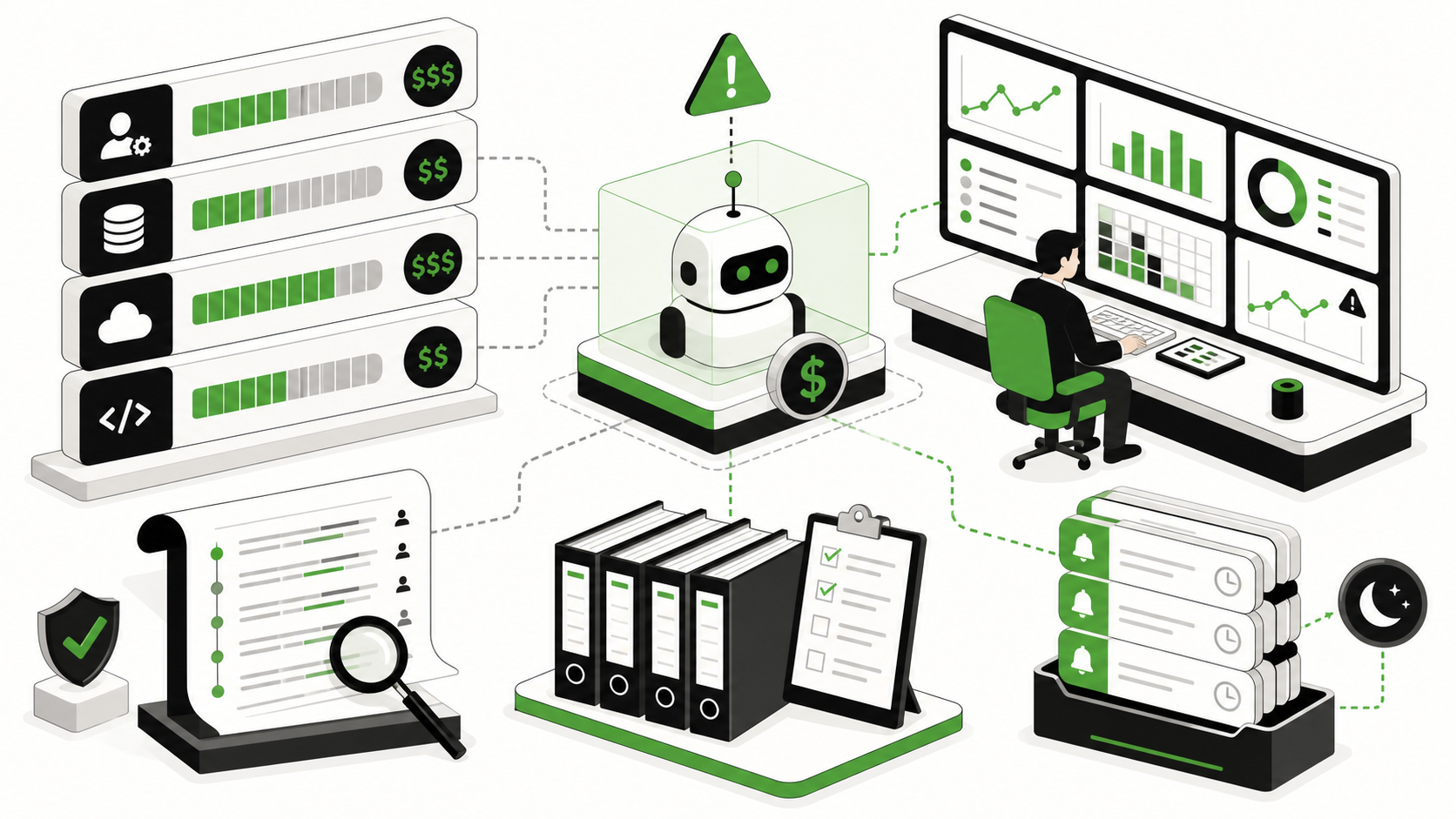
Beri’s analysis of AI agent ROI argues that real total cost can run significantly higher than the quoted cost once teams account for recovery, auditing, context maintenance, and monitoring. Whether the exact number is 40 percent or 60 percent, the direction is the important part: the hidden cost is not the model call. It is the operating environment.
Patrick Debois’ DEV Community post on the operational tax gives a useful example of compounding neglect. When teams skip maintenance, context grows, cost per run rises, failed runs increase, and debugging takes longer. That matches what we see with agent systems in general. Small failures do not stay small when they are allowed to accumulate.
At Emarketed, we have felt this in our own workflows.
Nova, our blog agent, is useful because it can move a daily content pipeline forward. But when the workflow was too loose, it could draft without finishing. That looked like activity, but it was not a completed publish. We had to harden the rule: a blog run is not done until the post, images, valid-links update, commit, push, live verification, and notification are complete.
Recon, our research and lead agent, is useful because it can help find and deliver verified leads. But a lead run is not successful because it found ten companies. It is successful only when ten verified leads are delivered to the CRM and Saleshandy. That distinction matters.
Our disk health checks are another example. Agents generate files. Images, audio, reports, browser caches, session logs, and temporary workspaces all accumulate. If nobody owns cleanup, the system eventually runs out of room. The solution is not a better model. It is a daily operational check, safe cleanup rules, off-box archiving, and alerts before the server is in trouble.
This is the real lesson: agents create leverage, but they also create surfaces that must be operated.
Agentic AI Needs Observability, Not Just Prompts
Sumant Thakur’s Agentic AI Is an Operational Problem, Not a Modeling Problem gets to the core issue: the hard part is keeping systems correct, observable, and controllable over time.
That is exactly right.
Most agent conversations still over-focus on prompts. Better prompts help, but prompts are not a production system. A production system needs:
- clear input sources
- versioned instructions
- safe tool access
- action boundaries
- audit logs
- retry rules
- escalation paths
- human approval states
- failure alerts
- periodic maintenance
If an agent sends an email, changes a website, updates a CRM, modifies a budget, generates a report, or publishes content, the business needs a way to reconstruct what happened.
That does not mean every agent needs enterprise software wrapped around it. It does mean that every useful agent needs an operating model.
For small businesses, this can be simple. Start with a checklist:
- What can the agent do without approval?
- What can the agent prepare but not send?
- What should happen only during business hours?
- What data is the agent allowed to use?
- Where does the agent write logs?
- Who gets notified when it fails?
- What counts as done?
- How often does the workflow get reviewed?
Those questions are not bureaucracy. They are what makes automation safe enough to keep using.
The Emarketed View: Start With One Agent You Can Operate
The wrong way to adopt agents is to automate everything at once.
The better way is to pick one workflow, define the success condition clearly, and build the operating wrapper around it.
For a marketing team, good first candidates include:
- weekly competitive research summaries
- draft-only blog research briefs
- internal SEO audit checks
- CRM lead enrichment for human review
- paid media anomaly alerts
- content refresh recommendations
- reporting prep before a strategist reviews it
The key is to separate preparation from publication. Agents are excellent at preparing work. Publishing, sending, charging, deleting, and changing live systems require more care.
That is why we usually recommend an agent maturity path:
- Let the agent observe and report.
- Let the agent draft and queue.
- Let the agent execute low-risk internal steps.
- Add human approval for external steps.
- Automate only after the logs prove the workflow is reliable.
That sequence may feel slower than the demo. It is also how you avoid building an automation system that creates more work than it removes.
This is especially important for agencies. When you are managing client work, the agent is not just touching your own data. It may affect client reports, client websites, paid media decisions, or lead pipelines. The operating standard has to be higher.
Where AI Agents Actually Create Value
None of this means agents are not worth it. We are bullish on them. We are building around them. We have an entire AI marketing agents service because the value is real.
But the value comes from disciplined implementation, not blind autonomy.
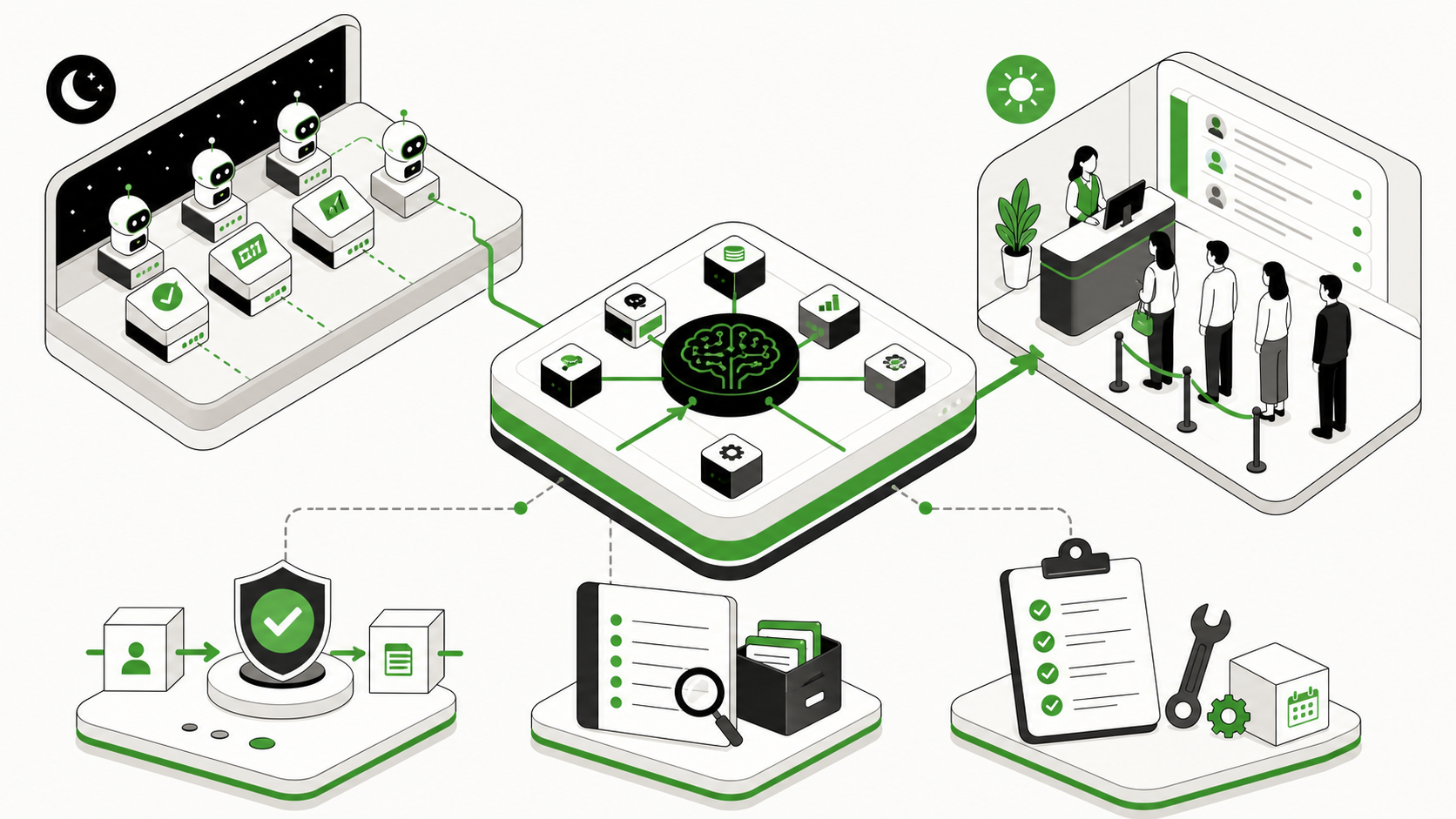
Agents are strongest when they:
- reduce repetitive research
- prepare structured drafts
- monitor recurring signals
- catch issues earlier than humans would
- keep workflows moving between human decisions
- make teams more consistent
- document what happened
They are weakest when teams ask them to make vague judgment calls, touch customers without guardrails, interpret messy business rules from memory, or operate without logs.
That is why the smartest agent work is usually not “replace a person.” It is “remove the repetitive operational drag around a person.”
A strategist should not spend an hour gathering screenshots before they can think. A content lead should not manually check whether a post has all its images. A sales team should not manually dedupe every company in a prospecting list. A founder should not have to remember whether a report was sent, a page deployed, or a workflow finished.
Agents can help with all of that. But only if the system defines what finished means.
A Practical Agent Ops Checklist
If your company is testing AI agents, use this checklist before you scale beyond the first workflow.
1. Define The Done State
“Draft created” is not the same as “post published.” “Lead found” is not the same as “verified lead delivered.” “Report generated” is not the same as “client-ready report approved.”
Write the done state in plain language.
2. Separate Anytime Work From Daylight Work
Let agents do internal preparation whenever they want. Queue anything that touches humans, money, public channels, or live systems.
3. Create Review Gates
Not every step needs approval. But high-risk actions should. Publishing, sending, deleting, changing budgets, contacting clients, and updating live systems should have explicit gates.
4. Log Every Meaningful Action
If you cannot answer “what happened?” after a failure, the agent is not ready for production. Logs are not optional for workflows that matter.
5. Budget For Maintenance
Prompts, SOPs, allowed tools, schedules, and review rules need upkeep. Put that in the operating plan from the start.
6. Watch The Total Cost
Track human review time, failed runs, rework, context updates, and monitoring effort. Direct model cost is only one line item.
7. Start Small And Prove Reliability
One reliable agent is more valuable than five impressive agents that require constant supervision.
The Bottom Line
AI agents are not going away. They are too useful. They can help marketing teams research faster, publish more consistently, monitor more surfaces, and keep complex workflows moving.
But the next competitive advantage will not come from having the most agents. It will come from having the most operable agents.
The teams that win will know which work can happen anytime, which work must wait for daylight, which actions require approval, how to detect failure, and how to keep agent context clean over time.
That is the shift businesses need to understand. Autonomy is not the same as operations. If you want agents to create real value, build the operating system around them.
If you want help thinking through where agents fit in your marketing operation, start with our AI marketing agents service or run a quick AI search visibility audit to see where automation can support your broader search and content strategy.
Frequently Asked Questions
Are AI Agents Worth It For Marketing Teams?
Yes, when they are scoped correctly. AI agents are useful for repeatable research, reporting, drafting, monitoring, and workflow coordination. They are risky when teams give them vague goals and direct access to external actions without review gates.
What Is The Hidden Cost Of AI Agents?
The hidden cost is the human and operational work around the model: review time, prompt maintenance, error recovery, context updates, monitoring, logging, and approvals. Those costs should be included in ROI calculations.
Should AI Agents Work 24 Hours A Day?
Internal work can run at any time. Human-facing work should usually be queued for business hours or approval. The important distinction is whether the agent is preparing work or taking an action that affects a person, customer, budget, or public channel.
Why Do AI Agent Projects Fail?
Many fail because the team treats the model as the whole system. In practice, successful agents need clear instructions, structured context, safe tools, logs, escalation rules, maintenance, and a definition of what counts as finished.
How Should A Business Start With AI Agents?
Start with one workflow that has a clear input, output, owner, and review step. Let the agent observe, draft, or prepare before it executes anything externally. Expand only after the workflow has proven reliable.