EU AI Content Labels Are Here: What US Businesses Should Do
The EU AI Act now requires transparency around some AI-generated copy, images, audio, and video. Here is what US businesses should understand before they publish.
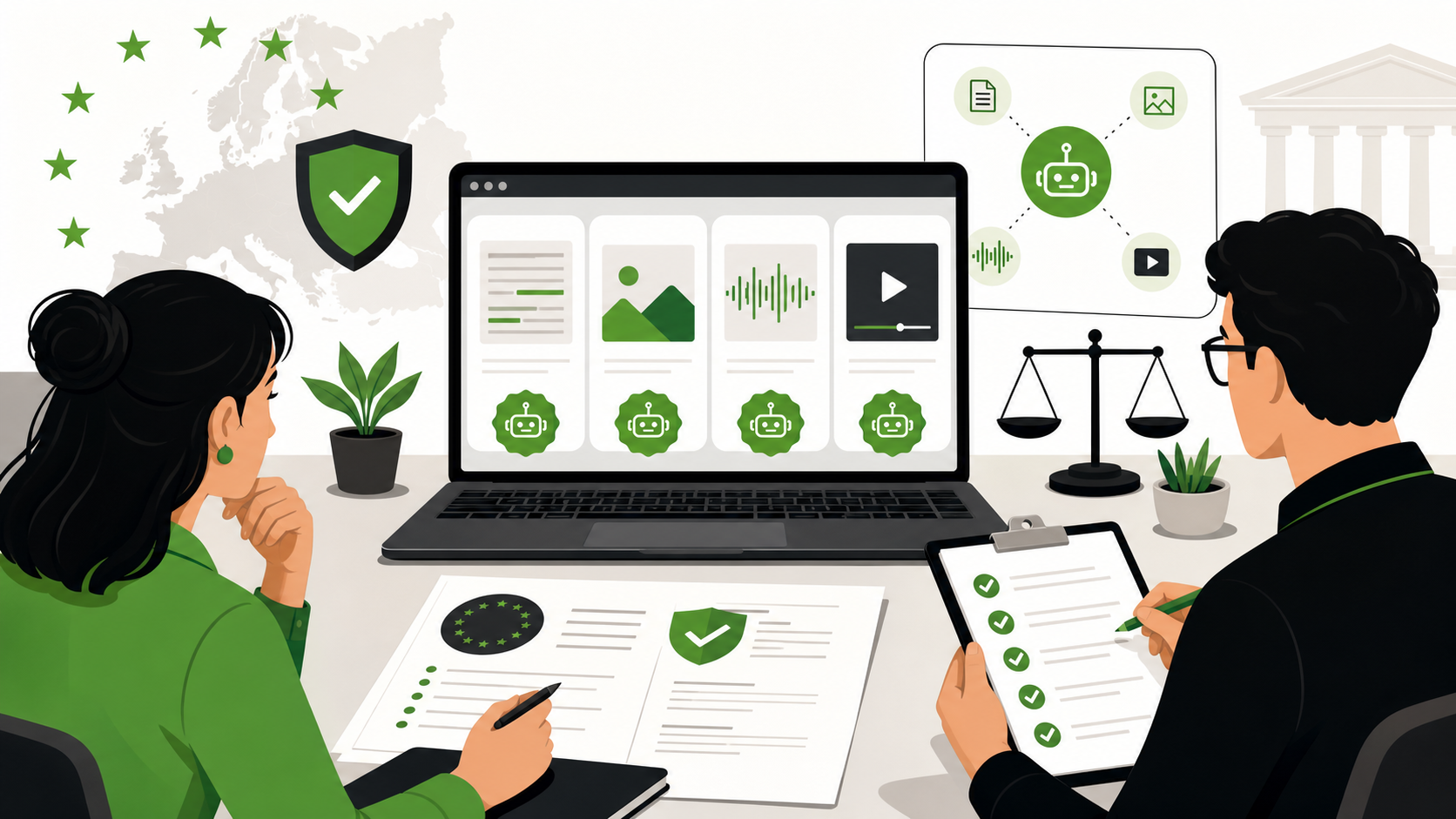
The EU’s AI transparency rules are now active, and US marketers should pay attention even if they never plan to open a European office.
On August 2, 2026, Article 50 of the EU AI Act started applying to transparency obligations for certain AI systems. The European Commission says the rules cover areas like AI interactions, AI-generated or manipulated content, deepfakes, and some AI-generated text published to inform the public on matters of public interest.
For a US business, the practical question is not “Does every AI-assisted blog post need a warning label?” The better question is: “When would a reasonable reader, customer, platform, regulator, or partner expect to know AI was involved?”
That is where the real marketing lesson sits. AI attribution is becoming less of a novelty and more of a trust signal.
What Actually Changed In The EU
The European Commission’s Article 50 transparency guidance says the rules apply from August 2, 2026 and cover providers and deployers of certain AI systems, including generative and interactive AI systems and deepfakes.
The obligations are split across different roles.
Providers of AI systems have to design systems so people are explicitly informed when they are directly interacting with AI, unless that is already obvious. Providers of generative AI systems also have to add machine-readable marks that help detect AI-generated or manipulated content.
Deployers, which can include companies using AI systems in public-facing work, have to inform people when they are exposed to certain AI uses. The Commission lists deepfakes, emotion recognition and biometric categorization tools, and text publications on matters of public interest without human review or editorial control.
That last phrase matters a lot for marketers.
The EU is not saying every AI-assisted email, caption, product description, or blog paragraph must carry the same label. The Commission’s FAQ on Article 50 says AI-generated or manipulated text published to inform the public on matters of public interest falls within the obligation only when specific criteria are met. It also makes clear that superficial checks, like spelling or grammar correction, are not the same as human review or editorial control.
In plain English: if AI generated public-interest text and no real person reviewed it, owned it, and took editorial responsibility for it, the disclosure risk is much higher.
What Counts As AI Content That May Need A Label
The Commission’s AI icon guidance says not all AI-generated or manipulated content needs to be labelled under Article 50. The disclosure requirement focuses on two main content categories:
- deepfakes, meaning AI-generated or manipulated image, audio, or video content that resembles existing people, objects, places, entities, or events and could falsely appear authentic or truthful
- AI-generated or manipulated text published to inform the public on matters of public interest, where there was no human review or editorial control and no person or company assumed editorial responsibility
That distinction is important. A lifestyle image created with AI for a generic blog header is not the same risk as a synthetic video that makes a real executive appear to say something they never said. A product caption drafted with AI and reviewed by a marketing manager is not the same risk as an automated AI news explainer published with no meaningful human review.
The EU also released optional icons that publishers may use to label certain AI-generated or manipulated content. The icons are not magic compliance shields. The Commission says they are optional, and using them alone does not prove legal compliance. But they are still a useful sign of where the market is heading: simple, visible, plain-language disclosure when AI could affect trust.
What This Means For US Businesses
Most US small businesses are not going to become EU AI Act experts overnight, and they do not need to. They do need a sane AI disclosure policy before the policy gets written for them by a platform, client, customer complaint, or regulator.
US companies should care for five practical reasons.
First, US companies can still have EU exposure. If your company sells into the EU, runs campaigns that target EU users, publishes apps available in the EU, provides AI tools to EU customers, or works with European partners, these rules may matter operationally.
Second, platforms tend to standardize. When large platforms adjust labeling, provenance, or disclosure workflows for Europe, those product changes often affect everyone. A US marketing team may feel the shift through ad systems, social platforms, CMS tools, AI vendors, and compliance checkboxes long before it hears from a regulator.
Third, buyers already care about authenticity. The legal rule is one layer. Trust is the bigger business issue. If customers discover that a testimonial, photo, spokesperson clip, expert quote, medical explainer, investment claim, or news-style article was AI-generated and not disclosed, the reputational damage can move faster than the legal question.
Fourth, the risk is not evenly distributed. A restaurant using AI to brainstorm menu captions has a very different disclosure profile than a healthcare company publishing AI-written treatment guidance. A local contractor using AI to polish a service page is not in the same category as a brand using synthetic video of a real person. Public interest, regulated industries, real people, health claims, financial claims, politics, emergencies, and news-style content all deserve more caution.
Fifth, AI content governance is becoming part of marketing operations. The Commission’s broader AI Act overview frames transparency as a trust issue: people should know when they are interacting with AI or seeing certain AI-generated content. That is not just an EU concern. It is the same direction customers, platforms, journalists, and enterprise procurement teams are moving.
A Practical AI Attribution Policy
The right answer is not to slap “made with AI” on everything. That can create noise and make real disclosures easier to ignore. The better answer is to create tiers.
Low-Risk Internal AI Assistance
This includes brainstorming, outlines, grammar cleanup, summarization, research organization, formatting, and draft support where a human reviews the final work and the content does not impersonate anyone or make sensitive claims.
For most US businesses, this does not need a public label. It does need internal standards. Keep a human editor accountable for accuracy, claims, tone, and final approval.
AI-Assisted Public Marketing Content
This includes blog posts, landing pages, ads, social posts, email campaigns, product copy, sales collateral, and resource pages where AI helped draft or shape the content.
If a person meaningfully reviews, edits, fact-checks, and owns the final publication, the EU’s public-interest text disclosure rule may not apply in the same way. But the business should still document who approved it, what sources support factual claims, and whether AI created any images, audio, or video assets.
For brands using content marketing, this is the workflow change that matters most: editorial control has to be real. A quick spell check is not enough.
Synthetic Media Or Deepfake-Adjacent Content
This is where labels become much more important. If AI creates or changes an image, voice, or video in a way that could make people believe something real happened, someone real appeared, or a real product, place, event, or person was represented authentically, disclose it clearly.
Examples include AI-generated spokesperson videos, synthetic customer clips, manipulated before-and-after visuals, AI voiceovers that imitate real people, fake event footage, altered property images, AI-generated product demos, and simulated news-style clips.
This is especially important for healthcare, finance, legal services, real estate, politics, education, and any business where trust and factual accuracy affect decisions.
Public-Interest Or Advice Content
When content informs the public about health, safety, finance, legal issues, public policy, civic topics, emergencies, or other high-impact subjects, treat AI use more carefully.
If AI drafts it, a qualified human should review it. If no qualified person reviews it, do not publish it as authoritative content. If the content is AI-generated and published without meaningful editorial control, a clear disclosure is the safer direction.
What To Put In The Disclosure
A good AI disclosure should be short, specific, and understandable.
For a synthetic image: “Image generated with AI.”
For a modified image: “Image modified with AI.”
For a synthetic video: “Video includes AI-generated visuals.”
For a synthetic voice: “Voice generated with AI.”
For an AI-assisted article with human review: “This article was drafted with AI assistance and reviewed by our editorial team.”
For many brands, the last version may not be necessary on every ordinary marketing page. But it is useful for public-interest explainers, research summaries, news-style posts, policy commentary, healthcare content, financial content, and any page where readers may reasonably care how the information was produced.
Keep the disclosure close to the content. Do not bury it in a privacy policy if the AI use affects how the content should be interpreted.
What To Do This Week
Create a simple AI content register. It does not have to be complicated. Track the asset, channel, AI tool used, whether AI created text, image, audio, or video, who reviewed it, what claims were fact-checked, and whether a disclosure was added.
Then update your publishing checklist:
- Does the content target or reach EU users?
- Is the content about a public-interest topic?
- Did AI generate or materially alter copy, image, audio, or video?
- Could the media be mistaken for a real person, place, object, event, or statement?
- Did a human editor meaningfully review and approve it?
- Is a short disclosure useful for trust, even if it may not be legally required?
That checklist is also useful for US-only marketing because it forces the right conversation before publishing.
AI content is not going away. Neither are labels, provenance tools, platform disclosures, and customer expectations around authenticity. The brands that handle this well will not sound defensive. They will sound professional.
For businesses using AI marketing agents or AI-supported publishing workflows, the next step is simple: make transparency part of the system, not a last-minute note added after the campaign is live.