Anthropic Is Watermarking Claude Output: What It Means For Marketers
Anthropic is adding machine-readable marks to Claude-generated text and files. Here is what AI watermarks mean for code, copy, images, and business content.
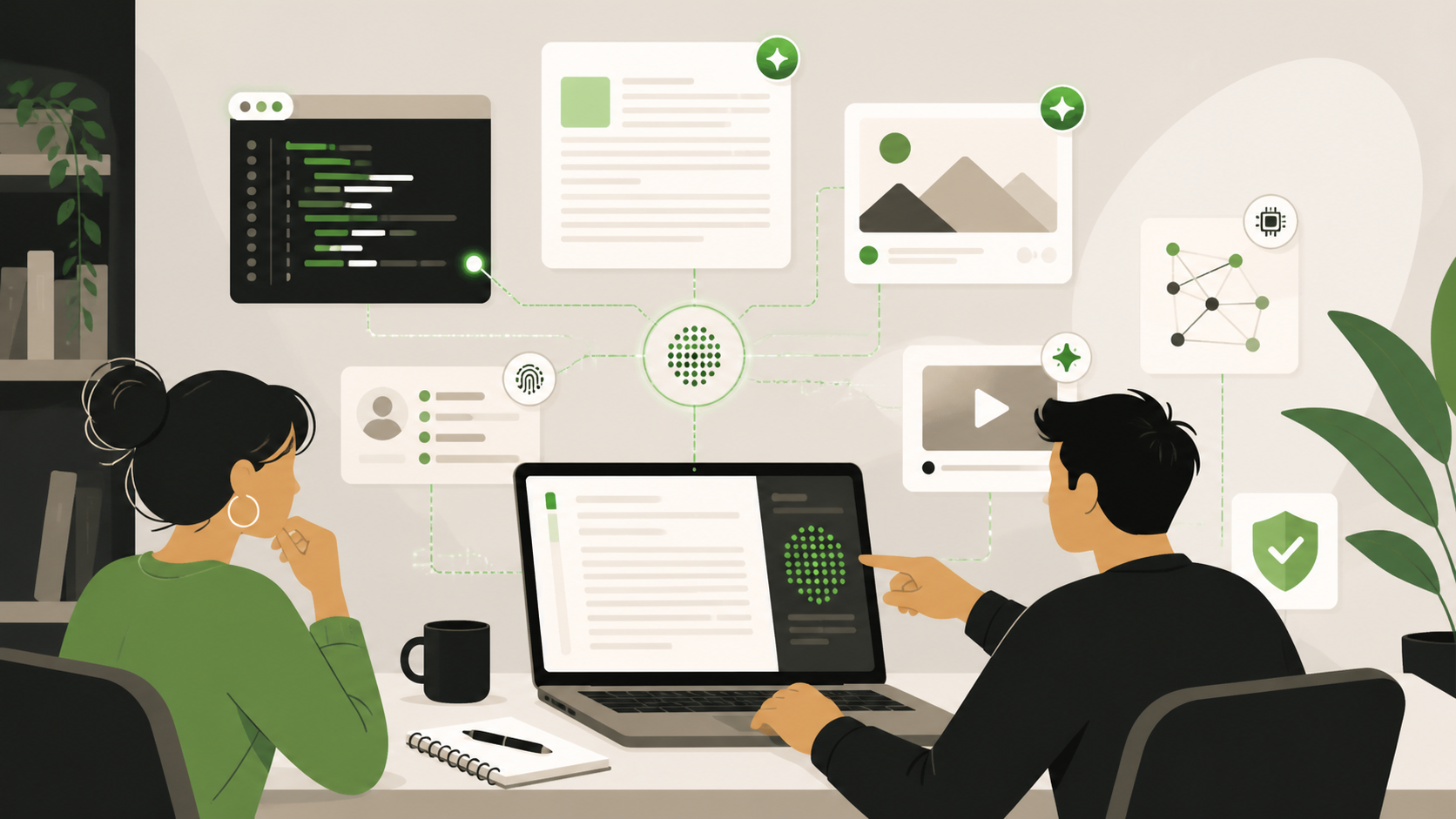
Anthropic’s Claude watermarking update is the first big example of what AI attribution rules may look like in daily business work.
If you saw the discussion on X this week and came away confused, that is understandable. The headline makes it sound like Claude will start dropping visible disclaimers into your code, blog drafts, emails, and images.
That is not really what is happening.
Anthropic says Claude will use two kinds of machine-readable marking: embedded watermarks in generated text and signed provenance metadata attached to generated files. The move is connected to the EU AI Act’s new transparency rules, but Anthropic is applying the approach globally across supported Claude products.
This is closely related to our post yesterday on EU AI content labels and what US businesses should do. The EU rule created the pressure. Anthropic’s rollout shows how AI companies may respond.
What Anthropic Actually Changed
Anthropic’s help article, How Claude marks AI-generated content, says Claude uses two complementary techniques.
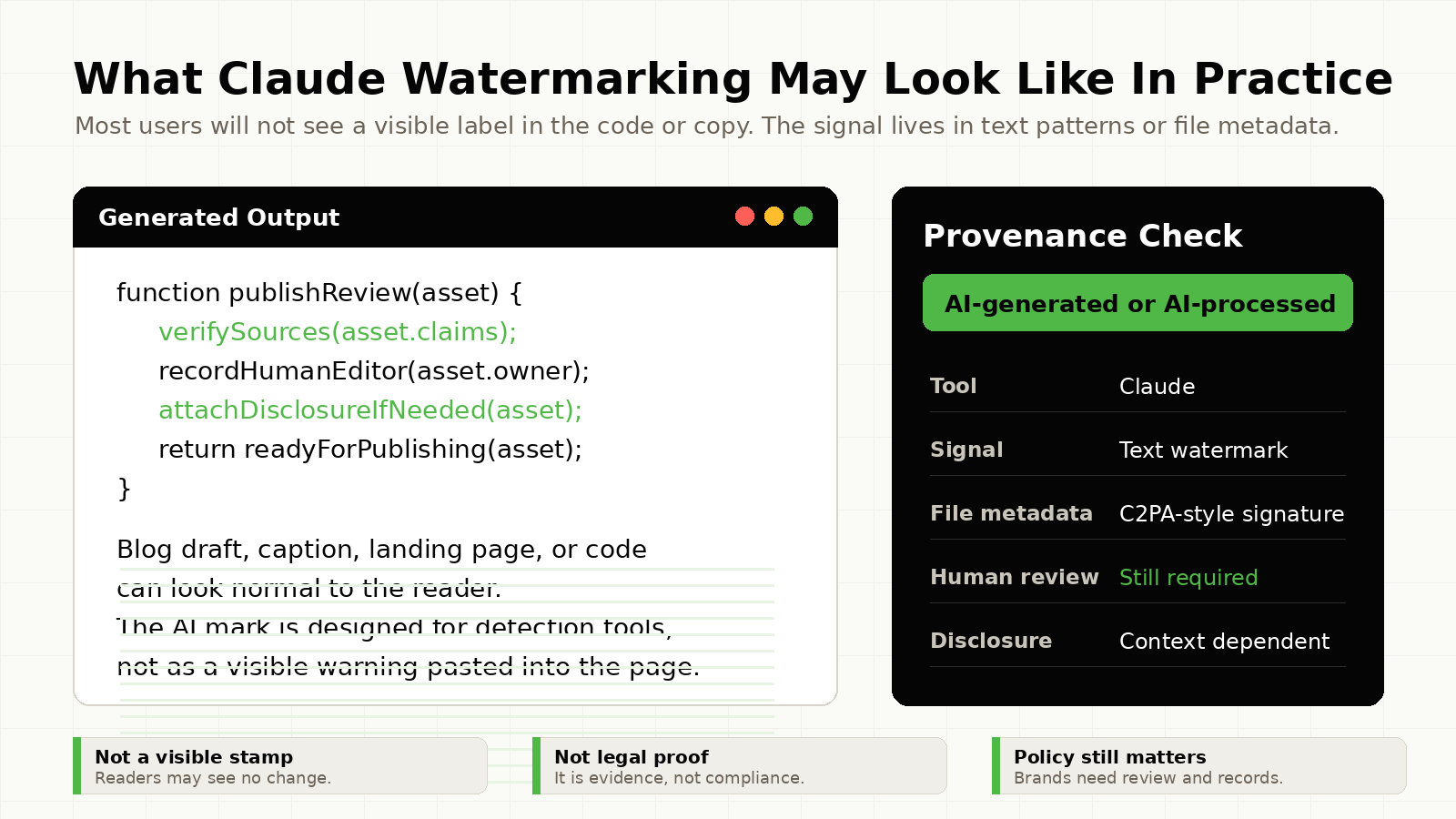
The first is text watermarking. Claude-generated text can carry a machine-readable signal that is not meant to be visible to human readers. Anthropic says this mark can remain after common actions like copying, pasting, and some editing.
The second is signed provenance metadata for files. When Claude creates supported files, those files can include digitally signed metadata that says they were generated or processed by Claude. Anthropic says this uses the C2PA standard, which is the same broad provenance framework many media, camera, and AI companies are moving toward.
The rollout matters because Anthropic says marking works across supported Claude models in Claude, Claude Platform API, Claude Code, Claude Cowork, Claude Tag, and cloud partner deployments where supported.
So yes, Claude Code is part of the conversation. But the practical issue is not that Claude will add a readable sentence at the top of every file saying “AI wrote this.” The issue is that generated text and supported files may carry machine-readable signals that downstream tools, platforms, institutions, or customers could eventually check.
Why This Is Happening Now
The timing lines up with the EU AI Act.
The European Commission’s Code of Practice on Transparency of AI-generated Content says Article 50 obligations apply from August 2, 2026. Those obligations cover marking and detection of AI-generated content, plus labelling of deepfakes and certain AI-generated public-interest text.
The Commission’s transparency guidance explains the split between providers and deployers. Providers of generative AI systems have to add machine-readable marks that enable detection of AI-generated or manipulated content. Deployers, meaning companies or organizations using AI systems in public-facing settings, may also have disclosure duties in specific cases.
Anthropic is a provider. That means it has a direct reason to build marking into Claude. A business using Claude is usually a deployer. That means the business still has to decide how AI output is reviewed, approved, disclosed, stored, and used.
This is the part many businesses will miss. Vendor watermarking does not replace your own publishing policy.
What This Means For Code
The code angle is why this blew up online.
Developers heard “Claude Code watermarks” and reasonably wondered whether generated code would contain hidden artifacts, weird formatting, invisible characters, or detectable patterns that could create problems in repos.
The safer way to think about it is this: AI-generated code is becoming part of the provenance conversation, not just the productivity conversation.
If Claude helps write a function, test, component, migration, or script, the question is no longer only “does it work?” The next questions are:
- who reviewed the code?
- where did the code come from?
- did the AI output include licensed or sensitive material?
- does the repository need an internal record that AI assisted?
- could a client, platform, buyer, auditor, or future tool ask whether this was AI-generated?
For most businesses, this does not mean you should panic about using Claude Code. It means AI-assisted development should stop being invisible inside the process.
The right workflow is simple. Treat AI-written code the same way you would treat junior developer work: review it, test it, document important decisions, and make sure a human owner approves it before it ships.
What This Means For Copy And Content
For marketing teams, the more immediate impact is copy.
If Claude helps draft a blog post, landing page, email, social caption, FAQ, case study, white paper, or ad concept, the text may carry a machine-readable watermark depending on the model and workflow used.
That does not automatically mean the finished article needs a public “written by AI” label. The EU rules are more nuanced than that, especially when there is meaningful human review and editorial responsibility. But the trend is obvious: AI content is getting easier to tag, trace, and question.
This makes weak content operations riskier.
If a company publishes lightly edited AI content under an expert byline, with medical, financial, legal, or public-interest claims, the issue is not only whether a hidden watermark exists. The bigger issue is whether the company can prove a qualified person reviewed it and took responsibility for the final version.
For everyday business content, the right standard is not fear. It is clean editorial control.
At Emarketed, that means AI can help with research, structure, drafts, summaries, and speed. But the final post still needs a human point of view, source checks, internal link review, claim review, and a clear reason to exist.
What This Means For Images, Audio, And Video
Anthropic’s file metadata approach points toward a broader media shift.
For images, audio, and video, the industry is moving toward provenance records that travel with files when supported. C2PA-style metadata can help identify whether a file was generated, edited, or signed by a tool. That is useful, but it is not perfect.
Metadata can sometimes be stripped when files are uploaded, compressed, converted, screenshotted, edited, or passed through platforms that do not preserve it. Text watermarks can be weakened by heavy rewriting, translation, mixing with human writing, or passing content through another model.
Anthropic is clear about the limits: a detected mark is not absolute proof that Claude authored the content, and the absence of a mark does not prove that AI was not involved.
That nuance matters for US businesses. Watermarks are evidence, not a complete compliance system. They help answer “where might this have come from?” They do not answer “is this accurate, legal, ethical, brand-safe, or ready to publish?”
What US Businesses Should Do Now
US companies should not wait for a US version of the EU AI Act before setting rules.
Start with a lightweight AI content policy:
- track which tools create or materially edit public content
- keep a human owner attached to every published asset
- disclose AI use when the content could affect trust
- be extra careful with public-interest topics, healthcare, finance, legal, politics, employment, education, and crisis information
- keep records for client work where AI played a meaningful role
- test and review AI-generated code before it enters production
- avoid using AI to imitate real people, customers, experts, executives, events, or testimonials without explicit consent and clear disclosure
This is not about making AI scary. It is about making AI usable at scale.
The companies that handle this well will not abandon AI. They will build normal operating rules around it. The companies that get sloppy will treat AI output like free raw material until a customer, platform, attorney, journalist, or client asks how it was made.
The Bottom Line
Anthropic’s watermarking update is a signal that AI transparency is moving from policy documents into everyday tools.
For marketers, this means AI-assisted content needs stronger editorial ownership. For developers, it means AI-assisted code needs review and provenance awareness. For business owners, it means the question is no longer whether AI was used. The question is whether the company can explain how it was used responsibly.
That is the shift US businesses should take seriously.
AI disclosure will not always be a visible label on the page. Sometimes it will be metadata, an invisible text watermark, a platform signal, or an internal record. But the direction is clear: AI-generated content is becoming more traceable, and brands should build trust before they are forced to defend it.