Affiliate Marketing in 2026: A Complete Guide for Small Business Owners
Learn how affiliate marketing works, how to build a profitable program, and why it's one of the highest-ROI growth channels available to small businesses today.
Key Takeaways
- Affiliate marketing lets you pay only for results, making it one of the most cost-efficient growth channels available
- Building a well-structured program requires clear commission structures, quality partner recruitment, and consistent tracking
- AI tools are transforming how brands discover affiliates, optimize offers, and detect fraud
- Small businesses and e-commerce brands see some of the strongest ROI from affiliate programs
What Is Affiliate Marketing?
Affiliate marketing is a performance-based channel where you pay partners — affiliates — a commission when they drive a specific action. That action is typically a sale, but it can also be a lead, a signup, or a download depending on your model.
The affiliate promotes your product or service through their blog, social channel, email list, or paid traffic. When a visitor clicks their unique tracking link and converts, the affiliate earns their commission. You pay for the result, not the attempt.
This pay-for-performance structure is what makes affiliate marketing fundamentally different from most advertising. A display ad charges you whether or not anyone buys. Affiliate marketing charges you only when someone does.
Why Affiliate Marketing Works for Small Businesses
Large brands have used affiliate channels for decades. What has changed is the accessibility. Affiliate networks, tracking software, and program management tools have dropped in cost significantly, putting the channel within reach of any business with an online presence.
For small businesses in particular, affiliate marketing solves a real problem: getting in front of new audiences without a massive paid media budget. Your affiliates do the prospecting. They already have the audience. They do the work of content creation, driving traffic, and making the introduction. You pay them from the revenue they generate.
The math is straightforward. If your product sells for $200 and you offer a 15% commission, you pay $30 per sale. If that $30 acquisition cost is within your margins, you have a scalable, self-funding growth channel.
How to Structure Your Affiliate Program
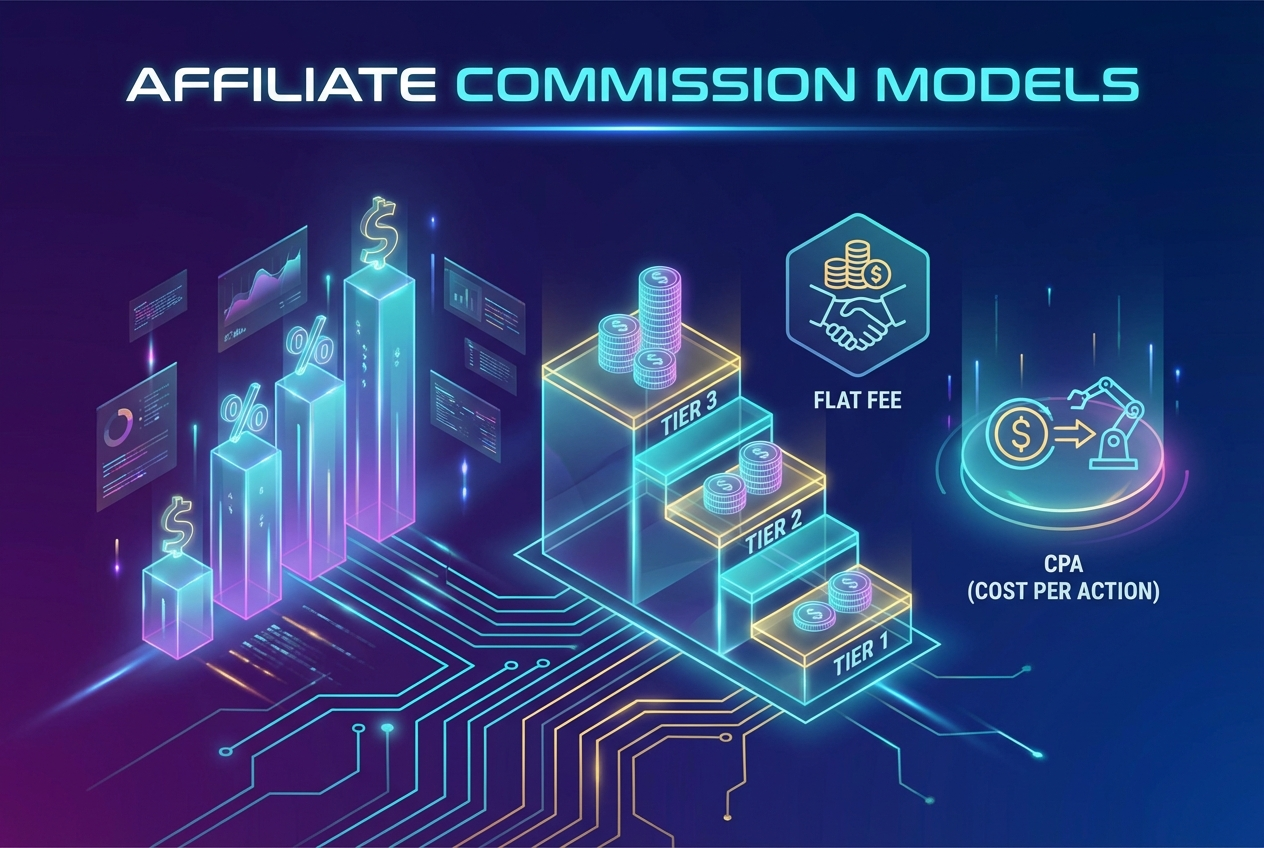
Commission Models
Revenue share is the most common model for e-commerce. You pay a percentage of each sale. Rates typically range from 5% to 30% depending on margins, product category, and how competitive your program needs to be.
Flat fee per sale works well when your average order value is consistent. Affiliates know exactly what they earn per conversion, which can simplify their math when deciding whether to promote you.
Tiered commissions reward volume. An affiliate who drives 10 sales a month might earn 10%, while one driving 50 sales earns 18%. This incentivizes your best partners to prioritize you over competitors.
CPA (cost per action) applies when the conversion is something other than a sale — a free trial signup, a quote request, a form fill. This works well for service businesses and B2B companies.
Cookie Duration
Your cookie duration determines how long after a click an affiliate gets credit for a conversion. Thirty days is the industry standard. Shorter windows frustrate affiliates and lose you good partners. Longer windows cost more in commissions on delayed conversions. Ninety days can be competitive for higher-consideration purchases.
Building Your Affiliate Partner Network
The quality of your affiliate program depends almost entirely on the quality of your partners. A hundred irrelevant affiliates will underperform ten highly aligned ones.
Where to Find Affiliates
Your existing customers are the most underutilized source of affiliates. People who already buy from you, love the product, and have an audience are natural partners. A simple email to your customer list announcing your affiliate program can surface your first dozen quality partners.
Content creators in your niche — bloggers, YouTubers, newsletter writers, podcasters — produce content that attracts exactly the audience you want. Search for content that ranks for terms related to your product. Those creators already have the SEO footprint and audience that makes them valuable partners.
Affiliate networks like ShareASale, Impact, and PartnerStack give you access to a marketplace of active affiliates looking for programs. You pay a network fee for the discovery and tracking infrastructure.
Influencers at micro and mid-tier levels often produce better ROI for affiliate programs than large accounts. A creator with 20,000 highly engaged followers in your niche will typically outperform a celebrity with 500,000 general followers.
Vetting Partners
Not every applicant deserves a spot in your program. Evaluate potential affiliates on:
- Audience alignment: do their followers match your customer profile?
- Content quality: is their work the kind you want representing your brand?
- Traffic legitimacy: are their metrics real, or inflated by low-quality sources?
- Existing partnerships: do they promote competitors in ways that conflict with your positioning?
A short onboarding call with your top prospects pays off. You will learn how they plan to promote you and whether they understand your product well enough to represent it accurately.
Tracking, Attribution, and Fraud Prevention
Reliable tracking is the backbone of any affiliate program. Without it, you cannot pay partners correctly, identify what is working, or detect fraud.
Tracking Fundamentals
Every affiliate receives a unique link that routes through your tracking system before landing on your site. The tracking system reads the parameter, drops a cookie, and attributes the sale back to that affiliate when the conversion fires.
Modern platforms handle this automatically. What you need to configure is:
- Attribution window: how long the cookie persists
- Last-click vs. multi-touch: which affiliate gets credit when multiple affiliates touched the same customer journey
- Coupon tracking: if affiliates use discount codes instead of links, the system must attribute those too
Fraud Detection
Affiliate fraud is real. The most common forms are cookie stuffing (affiliates overwriting legitimate cookies), fake leads, and self-referral (affiliates buying through their own links to earn commission on purchases they were going to make anyway).
Look for unusual patterns: abnormally high conversion rates, traffic from unfamiliar geographies, a sudden spike from a new partner. A good affiliate platform will flag anomalies automatically.

AI’s Impact on Affiliate Marketing in 2026
AI tools have changed how brands run affiliate programs across every stage.
Partner discovery: AI can analyze content at scale to identify creators whose audience demographics, content themes, and engagement patterns match your ideal affiliate profile. What used to take a team weeks now takes hours.
Personalized creatives: Affiliates perform better when they have assets that resonate with their specific audience. AI creative tools let you produce variations of banners, landing pages, and email copy tailored to different affiliate segments.
Fraud detection: Machine learning models identify behavioral anomalies that indicate fraudulent activity faster and more accurately than manual review. Suspicious patterns trigger automatic holds before payouts process.
Commission optimization: AI can model the relationship between commission rates, partner quality, and revenue outcomes to recommend optimal structures for different affiliate tiers.

Mistakes Small Businesses Make with Affiliate Programs
Launching with no promotional materials. Affiliates need banners, copy, product images, and information about your best offers. Leaving them to create their own assets leads to inconsistent and often poor-quality promotion.
Setting commissions too low. An uncompetitive rate will fail to attract quality partners. Research what similar programs in your industry pay before setting your rates.
Ignoring the program after launch. Affiliate marketing is not set-and-forget. The programs that perform best have active management: regular communication with top partners, seasonal promotions, updated assets, and ongoing recruitment.
Failing to provide a dedicated landing page. Sending affiliate traffic to your homepage loses conversions. A page that matches the message affiliates use to promote you dramatically improves conversion rates.
Not communicating. Affiliates who feel ignored move on. A monthly newsletter with performance updates, upcoming promotions, and new assets keeps your partners engaged and motivated.
Measuring Affiliate Program Performance
Track these metrics to understand program health:
- Revenue from affiliate channel: total sales attributed to affiliates
- Active affiliate rate: percentage of approved affiliates who drove at least one sale in the period
- EPC (earnings per click): average commission earned per click, which affiliates use to compare programs
- Commission rate by tier: are your tiered incentives driving the behavior you want?
- Fraud rate: what percentage of transactions were flagged or reversed?
- New vs. returning customer ratio: are affiliates bringing in new customers or converting existing ones?

Getting Started: Your First 90 Days
Days 1-30: Choose your platform (Reversion, Impact, ShareASale, or a lightweight option like Tapfiliate for small programs). Define your commission structure. Set up tracking. Create your core asset package: banner ads in standard sizes, email copy, and a product description document.
Days 31-60: Recruit your first affiliates. Start with your customer list, then outreach to 20-30 relevant content creators. Approve applications within 48 hours — slow approval kills momentum. Get each new affiliate their assets and answer questions quickly.
Days 61-90: Analyze your first data. Which affiliates are driving traffic but not converting? The issue might be landing page alignment. Which affiliates are converting but not getting enough traffic? They need promotional support or commission incentives to prioritize you. Optimize based on what you learn.
Frequently Asked Questions
How much does it cost to start an affiliate program?
At the low end, affiliate tracking software starts around $50-100 per month. Joining a major network like ShareASale involves a setup fee around $500 plus transaction fees. Budget additional funds for affiliate commissions once the program is active. A lean start is possible for under $200 per month.
What commission rate should I offer?
Research your industry. For e-commerce, 10-20% is common. Digital products can support 30-50% because margins are high. For services, a flat fee per qualified lead often makes more sense than revenue share.
Do I need a lot of traffic to start an affiliate program?
No. What affiliates care about is your conversion rate and commission potential. A site with a 4% conversion rate and a $150 average order is more attractive to affiliates than one with 10x the traffic but a 0.5% conversion rate.
How long does it take to see results?
Expect 3-6 months before meaningful volume. Affiliates need time to create content, build traffic, and optimize their promotions. The programs that grow fastest are the ones with active management and consistent partner communication from month one.