AI-Powered Content Prompt Generation: Boost Your Content Strategy in 2026
AI prompt generation has quietly become the engine room of modern content operations. Learn how to build systematic workflows that leverage AI for scale while preserving human oversight.

Content marketing has always been a volume game. More blogs, more social posts, more product descriptions, more emails. The teams that could produce quality content at scale won.
What’s changed is how that scale gets achieved. AI prompt generation has quietly become the engine room of modern content operations, and the teams figuring out how to use it effectively are pulling ahead.
The Market Reality
The numbers tell a clear story. According to Data Bridge Market Research, the global AI content creation tool market hit approximately $54 billion in 2024 and is projected to reach $222 billion by 2032, growing at nearly 20% annually. That’s not speculative investment chasing hype. That’s enterprise budgets flowing toward tools that deliver measurable returns.
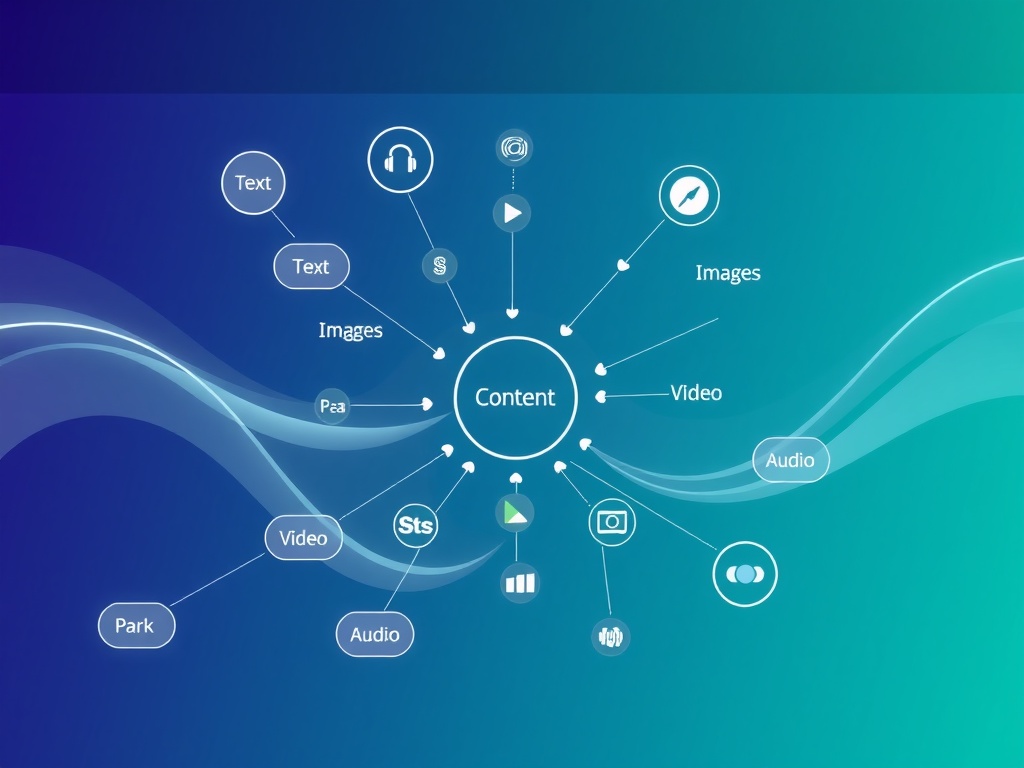
Text generation dominates the market, commanding over 20% of total share according to Grand View Research. It’s the foundational use case because it touches every department: marketing needs blog posts and ad copy, sales needs outreach sequences, product teams need documentation, support needs help articles. The demand is functionally unlimited.
Cloud deployment leads adoption because it solves the practical problems content teams face: remote collaboration, scalable compute, seamless updates. When your writer in Austin needs to collaborate with your strategist in London on a campaign launching next week, infrastructure matters. Roots Analysis projects cloud-based solutions will command roughly 65% of the market as teams prioritize accessibility over on-premise control.
Why Prompts Are the Real Skill
Here’s what most discussions about AI content tools miss: the tool matters far less than how you use it.
A mediocre prompt fed into the best AI model produces mediocre content. A well-crafted prompt fed into a decent model produces something you can actually use. The skill gap isn’t in selecting software. It’s in prompt engineering.

Effective prompts share common characteristics. They provide context about audience and purpose. They specify format, length, and tone. They include examples of what good looks like. They define constraints and requirements upfront.
The difference between “write a blog post about email marketing” and “write a 600-word blog post for B2B SaaS marketers explaining three email segmentation strategies that improve open rates, using a conversational but authoritative tone” is the difference between generic filler and content worth publishing.
Our AI Prompt Generator was built specifically for this challenge. It creates optimized prompts aligned with your brand voice and search intent, so you’re not starting from scratch every time you need content. The goal isn’t to replace the thinking. It’s to systematize the inputs so your outputs stay consistent.
Building a Prompt-First Workflow
The teams getting the most from AI content tools have restructured their workflows around prompt development rather than treating prompts as an afterthought.
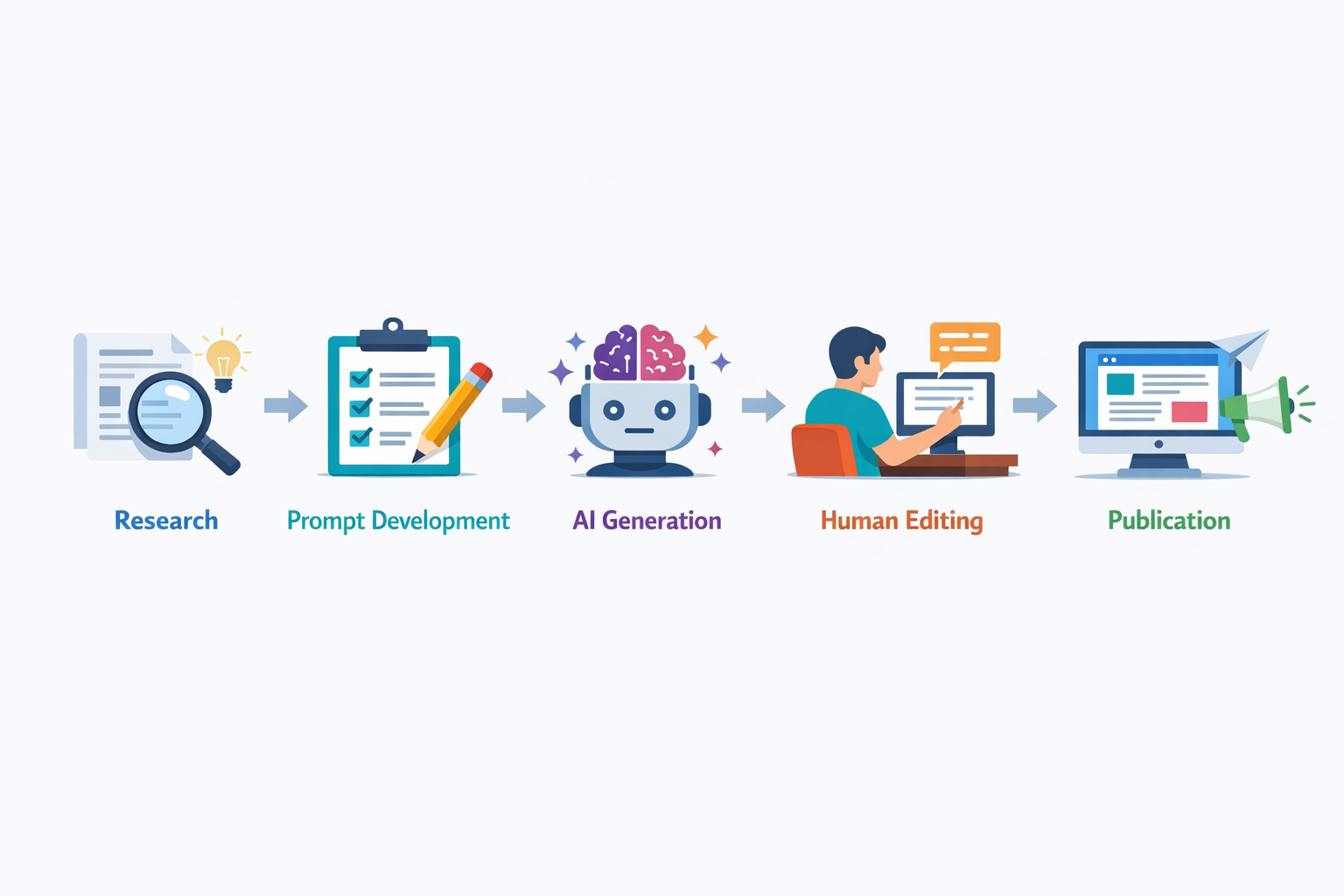
Start with research. Before writing a single prompt, understand what you’re trying to accomplish. What keywords matter? What questions is your audience asking? What gaps exist in competing content? Tools like the Keyword Researcher and Topic Authority Builder accelerate this phase, surfacing clusters and competitive insights that inform your content direction.
Then build your prompts systematically. Create templates for recurring content types. A blog post prompt template, an email sequence prompt template, a product description prompt template. Document what works. Iterate based on results.
Layer in human judgment. AI excels at volume and consistency. It struggles with nuance, brand voice, factual accuracy, and the kind of creative leaps that make content memorable. The workflow isn’t AI-then-publish. It’s AI-then-edit-then-publish. That editing step is where human expertise adds irreplaceable value.
The Efficiency Multiplier
What makes AI-generated content compelling isn’t that it produces perfect content. It doesn’t. What makes it compelling is the efficiency gain on the work that was already happening.
Consider the time breakdown for a typical blog post. Research takes an hour. Outlining takes thirty minutes. Drafting takes two hours. Editing takes an hour. Publishing and optimization take thirty minutes. That’s five hours per post.
With AI assistance, research might drop to thirty minutes if you’re using the right tools. Outlining becomes nearly instant if your prompt is well-constructed. Drafting drops to fifteen minutes of prompt iteration plus thirty minutes of editing the output. The total drops to under two hours.
That’s not a marginal improvement. That’s producing more than twice the content with the same resources. Or producing the same content and freeing capacity for strategy, promotion, and analysis. Menlo Ventures reports enterprise AI spending reached $37 billion in 2025, with AI tools showing a 47% deal conversion rate compared to just 25% for traditional SaaS—evidence that businesses are seeing real returns.
The Website Audit tool fits into this efficiency stack by identifying technical issues that undermine content performance. There’s no point accelerating content production if site speed problems or crawlability issues prevent that content from ranking.

Where the Mistakes Happen
Teams adopting AI content tools tend to make predictable errors.
The first is vague prompting. Without specificity, AI defaults to generic outputs that sound like everything else on the internet. Your content needs to reflect your brand’s perspective, your audience’s context, your unique angle. That only happens when your prompts encode those requirements.
The second is skipping the edit. AI-generated content often contains subtle factual errors, awkward phrasing, or logical inconsistencies. Publishing without review damages credibility and can trigger search engine penalties for low-quality content.
The third is ignoring the human element. AI can research, outline, and draft. It cannot understand your customer the way you do. It cannot make judgment calls about what to emphasize or downplay. It cannot bring authentic experience to a topic. Those elements still require human input.
Positioning for AI Search
One dimension many content teams overlook is optimization for AI-powered search engines. ChatGPT, Claude, Perplexity, and similar platforms are increasingly where research begins. Showing up in those responses requires different signals than traditional SEO alone.
The AI Search Optimizer checks how well your site is configured for these AI search platforms. The LLMs.txt Generator creates a structured file that helps AI systems understand your business, similar to how robots.txt guides traditional crawlers.
These aren’t replacements for solid SEO fundamentals. They’re additions to a foundation that should already be strong. But as AI-mediated search grows, the teams who address it early will have an advantage.
The Practical Path Forward
If you’re building or refining a content strategy in 2026, here’s what actually matters:
Invest in prompt development as a core competency. Document what works. Build templates. Iterate systematically. The quality of your prompts determines the quality of your outputs.
Keep humans in the loop. AI handles volume. Humans handle judgment. The combination is more powerful than either alone.
Measure efficiency gains, not just output volume. If AI tools aren’t saving time or improving quality, something in your workflow needs adjustment.
Stay current on AI search optimization. The discovery landscape is shifting. Early movers gain compounding advantages.
Build on fundamentals. Crawlability, site speed, content quality, user experience. These haven’t changed. They’ve just become table stakes rather than differentiators.
The teams winning with AI content aren’t the ones chasing every new tool announcement. They’re the ones who built systematic workflows that leverage AI for what it does well while preserving human oversight for what it doesn’t.
That approach won’t generate headlines. It will generate results.