How Los Angeles Small Businesses Are Using AI to Beat Big Competitors
AI adoption among small businesses jumped from 39% to 55% in one year. Here's how LA small businesses are using AI marketing tools to compete with larger companies and win.

AI is no longer something small businesses wait for. It is something the smart ones are already using to compete with companies three times their size.
The numbers back this up. According to Constant Contact’s 2025 Small Business Now report, AI adoption among small businesses jumped from 39% to 55% in a single year. In Los Angeles, where a boutique in Silver Lake competes with national chains and a contractor in the Valley fights for the same Google rankings as home services giants, that shift matters. The tools that used to require enterprise budgets and dedicated tech teams are now accessible, practical, and producing real results for businesses with lean operations.
Here is how it is actually working, and what LA businesses should be prioritizing in 2026.
The Playing Field Has Changed
The advantage large companies had in marketing was never strategy. It was infrastructure: bigger teams, bigger budgets, faster production, and more data. AI compresses that advantage significantly.
A small restaurant in Koreatown can now publish SEO-optimized content on a consistent schedule without a content team. A boutique agency in Culver City can run competitive analysis that used to require a research department. A solo contractor in the South Bay can respond to every inbound inquiry within minutes, around the clock, without hiring an answering service.
This does not mean small businesses automatically win. It means the gap has narrowed, and the businesses that take advantage of that narrowing are pulling ahead of the ones that are not.
According to Salesforce’s State of the Connected Customer report, 73% of customers now expect companies to understand their needs and expectations. AI is what makes that possible at scale for a business without a CRM team.
Local SEO: Where AI Has the Most Immediate Impact for LA Businesses
Los Angeles is one of the most competitive local search markets in the country. Every neighborhood is essentially its own market. “Plumber in Echo Park” and “plumber in Hancock Park” are different queries with different competitors and different customer profiles.
AI changes how you compete in that environment in three concrete ways.
Content production at neighborhood scale. AI tools can generate location-specific blog posts, service pages, and FAQ content targeting specific LA neighborhoods and search queries. A business that used to publish one generic service page can now build content that covers Westwood, Brentwood, Santa Monica, and Culver City with pages that address the specific context of each area.
Google Business Profile optimization. AI can analyze your GBP performance, suggest category updates, generate Q&A responses, and identify the types of posts that drive calls and direction requests in your specific category. For most local businesses, the GBP is their highest-converting asset, and most of them are leaving optimization on the table.
Review response and reputation management. Responding to reviews consistently is one of the strongest local ranking signals Google uses. AI tools can draft responses to new reviews in your brand voice within minutes of them being posted, keeping your profile active and engaged without pulling someone off other work to do it.
Our Local SEO Guide covers the full framework for LA businesses competing in neighborhood-level search, including the technical and content foundations that make AI optimization effective.
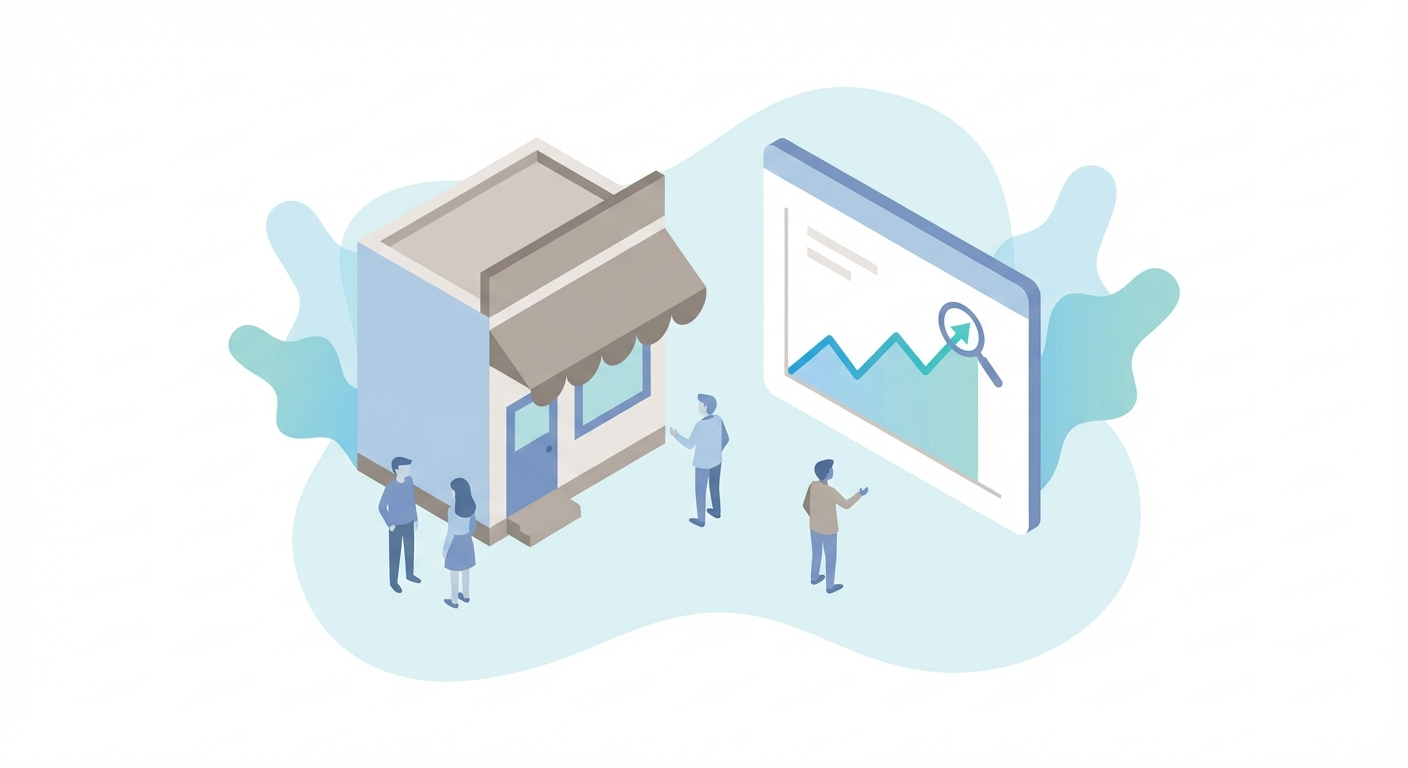
Five AI Marketing Strategies LA Small Businesses Are Using Right Now
1. AI-Powered Content and Social Media
The volume problem in content marketing has always been brutal for small businesses. You need to publish consistently to build authority, but producing consistent content requires time and a writing process most small teams do not have.
AI changes the production equation without changing the quality requirement. The businesses using this well are not publishing AI slop. They are using AI to handle research, outlines, and first drafts, then applying a human edit for voice, accuracy, and local context before publishing. The result is three to five times more content output from the same team.
On social media, AI handles caption generation, hashtag research, post scheduling recommendations, and performance analysis. Platforms like Buffer and Later now have AI built into their scheduling tools, making it practical for a one-person marketing operation to maintain a consistent presence across multiple platforms.
2. Automated Customer Response and Lead Qualification
Missing an inbound lead after hours is one of the most common and most preventable problems for small businesses in competitive markets. When a homeowner in Encino gets three contractor quotes, the one that responds first often wins, regardless of price.
AI-powered response tools can acknowledge inbound inquiries immediately, ask qualifying questions, and route hot leads for follow-up, all without a human in the loop at midnight. For service businesses, this alone can meaningfully change close rates.
3. Predictive Analytics Without a Data Team
Large companies have teams analyzing customer behavior, purchase patterns, and churn risk. AI platforms now surface the same insights for small business owners who have never used a spreadsheet for anything more complicated than a budget.
Tools like Klaviyo for e-commerce and HubSpot for service businesses apply predictive models to your own customer data to identify who is likely to buy next, who is at risk of churning, and which customers have the highest lifetime value. This changes how you allocate marketing spend.
4. AI Agent Teams for Marketing Operations
The most significant shift for small businesses in 2026 is not AI tools that assist with individual tasks. It is AI agents that handle entire workflows autonomously.
An AI agent can monitor competitor content, draft a blog response, schedule social posts, pull weekly analytics, and send a performance summary to your inbox, all without manual intervention. For an LA business owner managing everything from operations to sales to marketing, this kind of operational leverage is the difference between being reactive and being strategic.
We cover how businesses are building these agent workflows in detail in our post on OpenClaw for marketing teams, which walks through the practical setup for content pipelines, research automation, and reporting.
5. Smarter Paid Advertising
AI has transformed how small businesses run paid search and social campaigns. Google’s Performance Max campaigns use machine learning to optimize delivery across search, display, YouTube, and Gmail simultaneously. For a small business that used to manage separate campaigns for each channel, this consolidation cuts management time while often improving results.
The catch is that automated campaigns still require human judgment on the inputs: what you’re optimizing for, what audiences you want to exclude, and what your real cost-per-acquisition target is. AI optimizes toward the goal you set. Setting the right goal still requires someone who understands your business.

What Most Small Businesses Get Wrong About AI Marketing
The most common mistake is treating AI as a cost-cutting tool rather than a leverage tool. Businesses that use AI to do the same things with fewer people usually get worse results than before. Businesses that use AI to do more things, faster, with the same people, are the ones pulling ahead.
The second mistake is starting too broad. Businesses that try to automate everything at once end up with a collection of half-configured tools that nobody uses consistently. The businesses succeeding with AI in 2026 almost all started with one workflow, got it working, and expanded from there.
The third mistake is skipping the strategy layer. AI can execute faster than any human team. But if you are executing the wrong strategy faster, you just get to the wrong outcome more quickly. The return on AI investment is highest when it is paired with a clear understanding of your audience, your competitive position, and what you are trying to achieve.
Our AI Marketing Agents service is built around this sequence: define the workflow, configure the agent precisely, and expand only after the first use case is producing reliable results.
Where to Start if You Have Not Yet
The most useful starting point depends on where you are losing the most time or the most leads right now.
If it is content: start with an AI drafting tool and build a publishing workflow around it. Even two quality posts per month, published consistently, outperforms eight posts that come in bursts when someone has time.
If it is lead response: set up an AI-powered first-touch system for inbound inquiries. You do not need a complex CRM to do this. Most email and chat tools now have this built in or available as an integration.
If it is reporting: use our AI Keyword Researcher to get a clear picture of where your current search visibility stands, and identify the gap between where you are and where your competitors rank.
If it is overall operations: read up on agentic AI marketing and start thinking about which workflows in your business are high-volume, repeatable, and currently eating time that should be going toward growth.
Frequently Asked Questions
Do small businesses in Los Angeles actually need AI marketing tools, or is this hype? The adoption numbers suggest it is real. AI adoption among SMBs jumped 16 percentage points in a single year, and the businesses using it report measurable time savings and improved output. The hype is around AGI and automation replacing jobs. The practical reality for small businesses is narrower and more immediately useful: AI handles repetitive tasks faster, so your team can focus on work that requires judgment.
How much does AI marketing cost for a small business? Most entry-level AI tools start at $0 to $50 per month, with more capable platforms in the $100 to $300 range. The ROI calculation for most small businesses is straightforward: if an AI tool saves five hours of staff time per month at any reasonable hourly rate, it pays for itself. The more relevant question is not cost but configuration: an unused tool at any price is not a good investment.
Which AI marketing tools are best for local LA businesses? It depends on your primary need. For local SEO: tools that integrate with Google Business Profile. For content: any solid AI writing assistant paired with your own editing. For paid ads: Google’s native AI optimization is already built into campaigns you are likely already running. For full marketing operations: an agent platform like OpenClaw that handles workflows across content, research, and outreach from a single interface.
Can AI help a small business compete with national chains in LA? In specific ways, yes. AI levels the content production and local search optimization playing field significantly. Where national chains retain advantages: brand recognition, review volume, and domain authority built over years. AI cannot shortcut those entirely. But it can help a local business consistently show up in the right searches, respond faster, and produce more content than a national chain’s local team is doing for your specific market.
How long does it take to see results from AI marketing? For local SEO, meaningful movement typically takes three to six months. For paid ad optimization using AI, improvements can show up in weeks. For content and social, results compound over time: the first month looks modest, the sixth month looks very different. Set 90-day benchmarks and measure against them.
The Advantage Window Is Still Open
AI adoption among small businesses is rising fast. But the businesses using it strategically, rather than experimentally, are still a minority. The window to build a meaningful competitive advantage through AI in the LA market is open now. It will not stay open indefinitely.
The businesses that figure out one solid AI workflow in the next 90 days will be better positioned than the ones that spend another six months evaluating tools. Start with the workflow that costs you the most time. Get that one working. Then build from there.