The AI-Era Marketing Funnel Is Broken. Here Is How to Rebuild It.
AI search is collapsing the top of the marketing funnel and making the middle invisible. Here is what the buyer journey actually looks like in 2026 and how to rebuild your funnel around it.
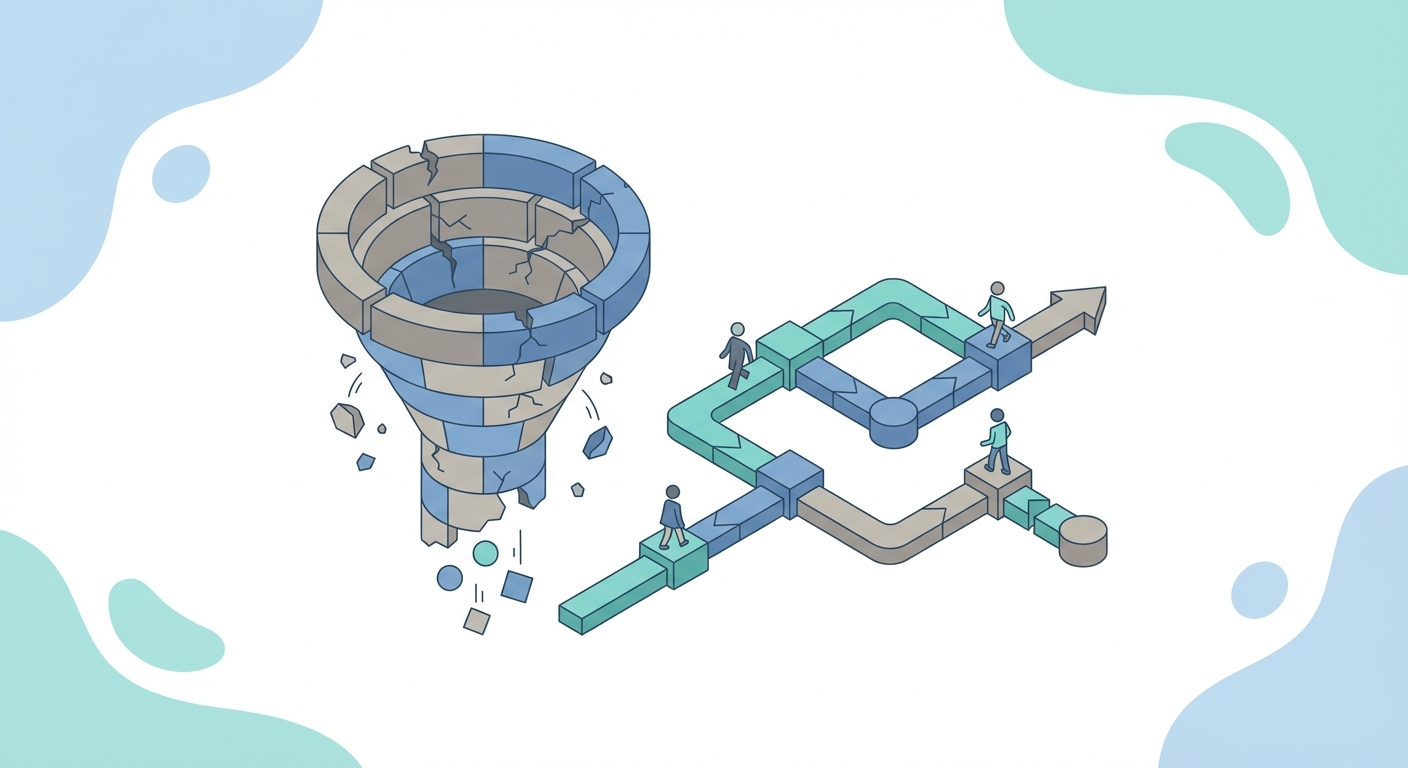
The marketing funnel you built your strategy around was designed for a different internet. One where people typed a query, got a list of ten blue links, clicked through to your blog post, subscribed to your email list, and eventually converted after a few nurture touches. That sequence still exists. It is just no longer the dominant path.
Search Engine Land reports that AI assistants are expected to handle a quarter of all search queries in 2026, and the effect on traditional funnels is already visible: the top of the funnel is shrinking, the middle is becoming invisible to tracking, and buyers are arriving at the bottom with far less engagement history than they used to.
The funnel is not dead. But the version most agencies are running is broken. Here is what actually changed, and how to rebuild around what the buyer journey looks like now.
What the Traditional Funnel Assumed
The classic TOFU/MOFU/BOFU model rested on a few assumptions that no longer hold cleanly.
Assumption 1: Awareness happens on channels you control. Blog posts, paid ads, social content. You put something out, people find it, and you can track the touchpoint. AI search changes this. When someone asks ChatGPT or Perplexity a question and gets an answer that includes your brand, the awareness happened inside a platform you do not own, did not pay for, and cannot directly measure.
Assumption 2: The middle of the funnel is a journey you can influence. You publish comparison content, case studies, and email sequences. Buyers read them and move closer to a decision. But Gartner research shows that 83% of the buyer’s journey now happens before they ever talk to a salesperson, and a growing portion of that research happens inside AI interfaces where your content may or may not surface.
Assumption 3: You know where leads come from. Attribution was already imperfect. Now it is genuinely difficult. Buyers discover your brand in an AI answer, do more research through a combination of AI queries and direct searches, and show up to a demo with no clear trackable path. The referral source says “direct” or “organic,” but the actual journey was invisible.
None of this means funnels stop working. It means the funnel has to be rebuilt around a different reality.

How the Buyer Journey Actually Flows in 2026
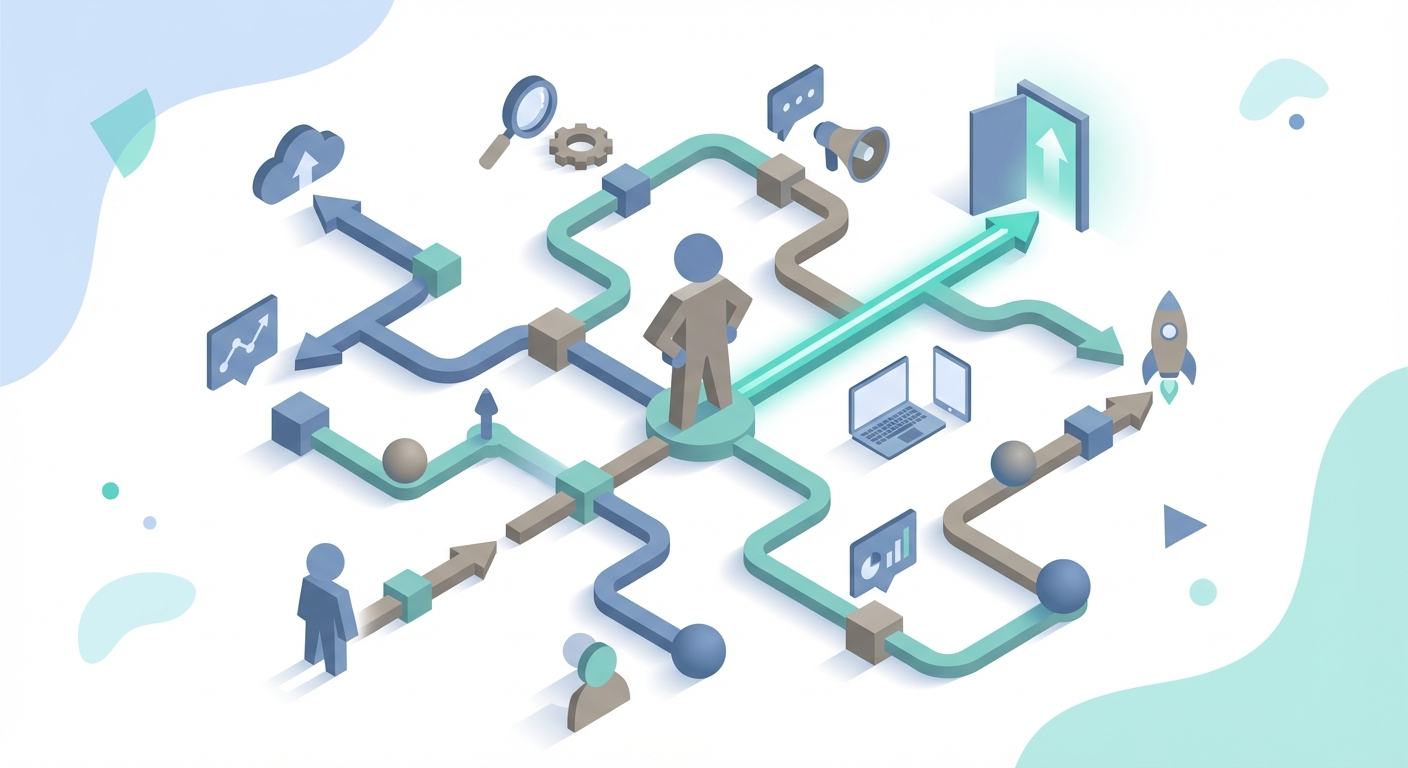
MarketingProfs describes it clearly: today’s buyer journeys are non-linear, multitouch, and often invisible to traditional tracking methods. Research from Destination CRM analyzing nearly 20,000 purchase decisions found that 63% of buyers add new brands to their consideration set after they have already started evaluating. They do not narrow down in a straight line. They expand, pivot, and reconsider.
The modern buyer journey looks more like this:
Stage 1: AI-mediated awareness. A potential buyer asks an AI a broad question about their problem. The AI answer may mention your brand, your competitors, or neither. This stage is largely outside your direct control but heavily influenced by your content footprint, your E-E-A-T signals, and whether your site is structured to be cited.
Stage 2: Direct and blended research. The buyer follows up with more specific searches, a mix of traditional Google results, AI Overviews, Reddit threads, YouTube videos, and peer recommendations. Your blog posts, comparison pages, and review presence all matter here, but so does your visibility in AI-generated answers for mid-funnel queries.
Stage 3: Trust and validation. Before converting, buyers look for confirmation they are making the right choice. This is where case studies, reviews, social proof, and clear differentiation do their work. This stage often happens in places you cannot track: a Slack message to a peer, a screenshot shared in a group chat, a quick ChatGPT query asking “is [your brand] legit?”
Stage 4: Conversion. The buyer takes action. They may have touched your brand a dozen times across channels before this moment. Most of those touches are invisible in your attribution model.
What This Means for Each Stage of Your Funnel
Top of Funnel: Optimize for AI Citation, Not Just Rankings
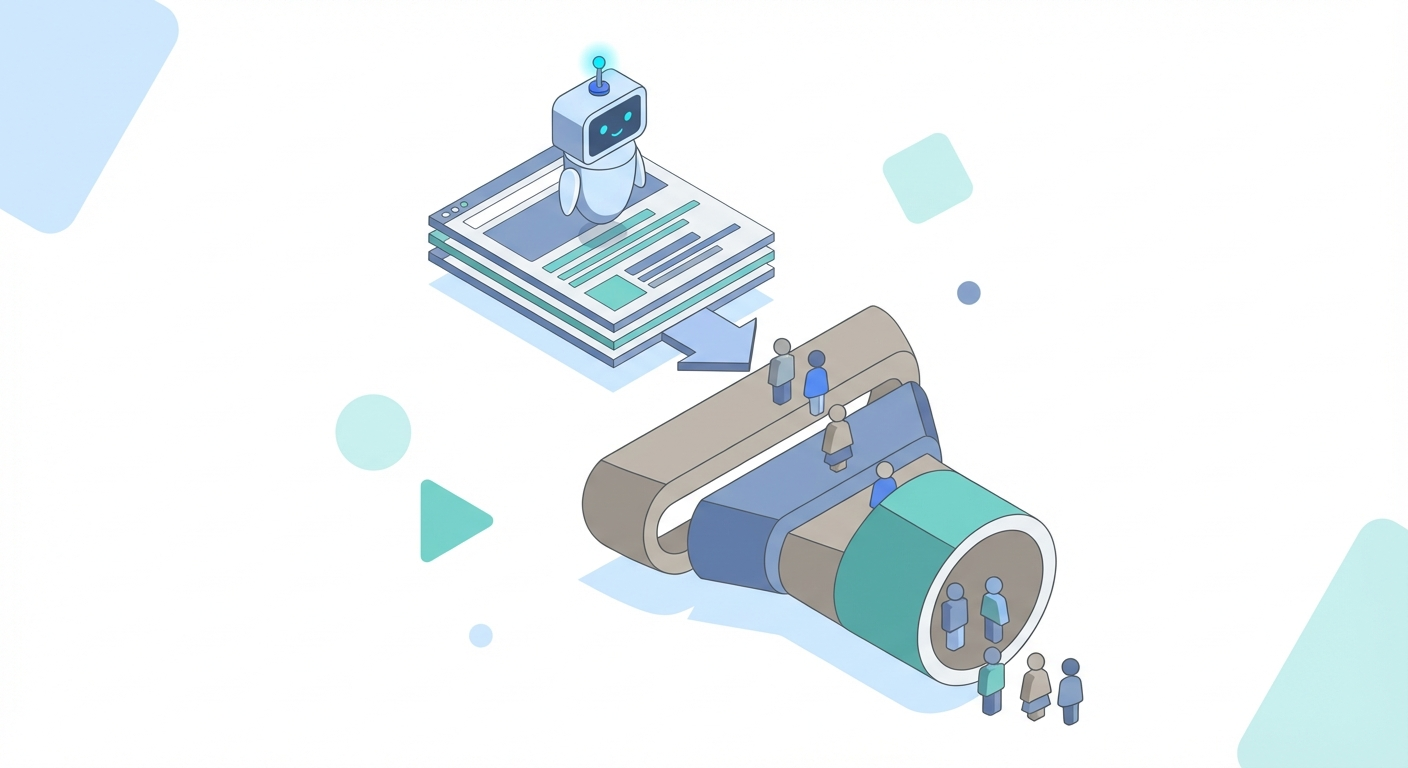
The top of the funnel used to mean ranking for broad informational keywords. That still matters, but it is no longer sufficient. If AI systems are answering the questions your TOFU content used to answer, and not citing you in those answers, you are losing awareness to competitors who have structured their content to get cited.
This is the core of AEO: building content that AI systems recognize as authoritative, direct, and worth including in generated answers. That means leading with the answer rather than building to it, using structured formats that are easy to extract, and covering the questions your buyers actually ask rather than the keywords your tool shows volume for.
Our post on how Google AI Overviews are changing agency strategy goes deep on the tactical side of this, including how to audit your current AI visibility and which content formats perform best.
Middle of Funnel: Make the Invisible Journey Visible Where You Can
The middle of the funnel is where most funnels leak, and AI search has made the leakage worse by moving more of the research process off your owned channels.
Two things help here.
First, build content that serves the mid-funnel AI query specifically. Buyers in evaluation mode ask different questions than buyers in awareness mode. They ask about comparisons, specific use cases, pricing structures, and “is this right for my situation” scenarios. If your content answers those specific questions directly, it has a much better chance of being cited when a buyer asks an AI assistant that question.
Second, use every conversion opportunity to capture email addresses or start a direct relationship. Email is the one channel you own in a landscape where every other channel can change its algorithm, its pricing, or its accessibility. Mid-funnel content that offers something in exchange for contact information gives you a trackable path back into a buyer journey that is otherwise invisible.
Bottom of Funnel: Trust Is Now the Conversion Variable
The bottom of the funnel has not changed as dramatically as the top, but the trust bar is higher. Buyers who have researched through AI channels arrive more informed than they used to be, which means your bottom-of-funnel content needs to work harder to differentiate, not just inform.
The assets that do the most work at the bottom of the funnel in 2026:
Specific, verifiable case studies. Not “we helped a client increase traffic by 40%.” The industry, the starting point, the specific challenge, the approach, the measurable outcome, and the timeline. AI systems can generate generic claims. Your real client results are the one thing they cannot fabricate.
Clear, honest differentiation. Why you and not the three other options a buyer found in the same AI search. Most agencies and businesses struggle to articulate this in a way that is actually distinct. If your differentiation is “we care about your results” or “we’re a full-service team,” you do not have differentiation. You have filler.
Direct conversion paths for high-intent visitors. If someone has done their AI-mediated research and arrived at your site ready to evaluate seriously, the barrier to starting a conversation should be as low as possible. Clear CTAs, specific calls to action tied to where they are in their journey, and ideally a way to begin without a lengthy discovery form.
For a deeper look at how AI search is specifically affecting where buyers find you, our post on zero-click AI search and what it means for traffic covers the attribution problem and how to measure visibility when clicks are declining.
Rebuilding the Funnel: A Practical Framework
Rather than trying to optimize the old funnel, rebuild it around three questions:
1. Where does AI mention you, and for which queries? Run a systematic audit of your brand’s AI visibility. Which questions trigger a mention? Which competitor-comparison queries return results that include you? Which high-value queries return answers that do not include you? Use our AI Search Optimizer to get a baseline before you start optimizing.
2. Where does the buyer go after they discover you? Map the touchpoints you can see. Where do people land when they arrive direct? What do they do on site? Which pages appear most often in the paths before a conversion? You will never have complete data, but the data you have tells you where your mid-funnel content is doing its job and where it is not.
3. What turns a warm lead into a ready buyer? Interview your recent customers. Specifically ask: what made you confident you were making the right choice? What almost made you go with someone else? The answers will tell you what trust signals matter most at the bottom of your funnel and where your current assets are falling short.
Our Lead Gen service is structured around exactly this kind of funnel rebuild, starting with the buyer journey map before touching any campaign or content.
Frequently Asked Questions
Is the marketing funnel actually dead or just changing? Changing significantly, not dead. Buyers still move from awareness to consideration to decision. What has changed is how each stage works, how visible it is to marketers, and how much of it is mediated by AI rather than owned channels. The funnel as a mental model is still useful. The specific tactics built for the old version of it need rebuilding.
How do you measure a funnel when AI search makes attribution harder? Focus on a mix of direct attribution where it is available and leading indicators where it is not. Track AI citation frequency for target queries, brand search volume trends, direct traffic growth, and email list growth as proxy metrics for awareness-stage impact. For conversion stages, you can still measure directly. The middle is the hardest to track, which is why building mid-funnel email capture matters more than ever.
What content formats work best for AI-era top-of-funnel? Direct answer formats. Open with the answer to the question, then support it with context. FAQ sections with specific questions and concise answers. Comparison content that directly addresses “X vs Y” queries. Structured definitions and explainers. These formats are more likely to be extracted and cited by AI systems than narrative-heavy blog posts that bury the answer in the third paragraph.
How does AEO fit into the funnel rebuild? AEO addresses specifically the top of the funnel, making sure AI systems cite your content when buyers are first researching their problem. It is a prerequisite for the rest of the funnel working, because if you are invisible at the awareness stage, buyers are building their consideration set without you.
Should we still invest in traditional SEO alongside AEO? Yes. Traditional search results still handle the majority of queries, and a significant portion of mid-funnel research still happens through standard Google searches. AEO and SEO reinforce each other: content structured to answer questions clearly tends to rank well in both traditional search and AI-generated answers. The optimization principles overlap more than they conflict.
How long does it take to rebuild a funnel around AI search? The content and technical changes needed for better AI citation can be implemented in weeks. Seeing meaningful movement in AI visibility typically takes two to four months. Rebuilding the mid-funnel with the right email capture, nurture sequences, and trust assets is a three to six month project when done properly. The full funnel rebuild is not a single sprint. It is a roadmap.
The Funnel Is Not Smaller. It Is Harder to See.
The buyer journey has not gotten shorter. If anything, buyers are doing more research, across more channels, before they convert. What has changed is how much of that journey is visible to you. AI search moved significant portions of the awareness and consideration stages into interfaces you do not own and cannot directly track.
The response is not to abandon the funnel model. It is to rebuild each stage around the reality of where buyers actually are: optimizing for AI citation at the top, capturing relationship and email at the middle, and sharpening trust and differentiation at the bottom.
The agencies and businesses that rebuild their funnels around this reality in 2026 will be the ones with the cleaner pipelines, the lower cost per acquisition, and the stronger brand presence when buyers arrive ready to convert.