Mastering AI-Driven SEO: Strategies to Outperform Competitors in 2026
AI doesn't replace the strategic thinking that makes SEO work. It accelerates it. Learn where AI adds real value to your SEO workflow and where it just adds noise.

The conversation around AI and SEO has shifted. We’ve moved past the “will AI replace SEO?” panic and into something more practical: how do we actually use these tools to get better results?
The answer isn’t complicated, but it does require a change in mindset. AI doesn’t replace the strategic thinking that makes SEO work. It accelerates it. The agencies and in-house teams pulling ahead right now aren’t the ones with the fanciest tools. They’re the ones who figured out where AI adds real value and where it just adds noise.
Where AI Actually Moves the Needle
Let’s be specific about what AI does well in an SEO context, because the hype makes it hard to separate useful applications from marketing fluff.
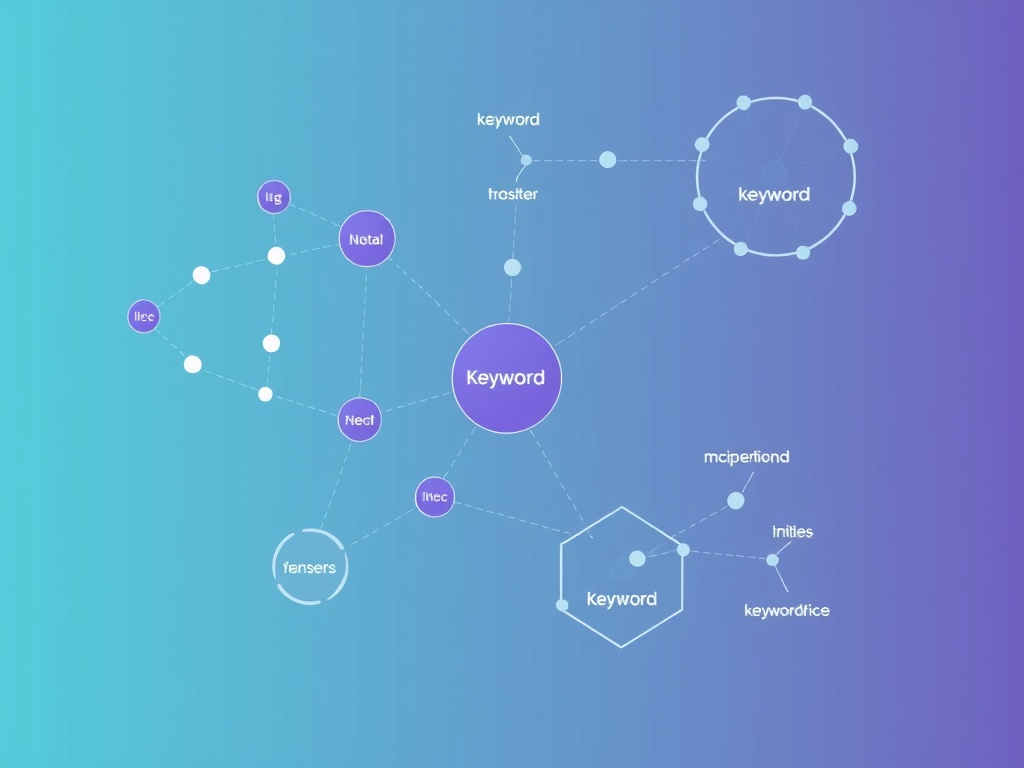
Keyword research at scale. Traditional keyword research meant pulling data from one or two tools, manually grouping terms, and building spreadsheets. It worked, but it was slow. AI-powered keyword tools can now cluster thousands of terms by intent and semantic relationship in minutes. The output still needs human review, but you’re starting from a much stronger position.
Content gap analysis. Finding what your competitors rank for and you don’t used to be a multi-hour project. AI tools can surface these gaps quickly and prioritize them by opportunity size. The strategic decisions about which gaps to pursue remain yours, but you’re making those decisions with better information.
Technical audits with context. Crawling a site and generating a list of errors isn’t new. What’s changed is the ability to prioritize those errors based on likely impact and get plain-language explanations of what’s actually broken. This matters especially for teams where the SEO specialist isn’t also a developer.
Content optimization that goes beyond keyword density. The old approach was mechanical: hit a target keyword count, sprinkle in some variations, call it optimized. AI tools now analyze top-ranking content for structure, depth, and semantic coverage. They can tell you not just which words to include, but which subtopics you’re missing entirely. For a deeper dive into this approach, check out our SEO Fundamentals guide.
Building a Workflow That Actually Works
Here’s where most teams go wrong: they add AI tools without rethinking their process. You end up with more outputs to review but no real efficiency gain.
A better approach is to map your current workflow and identify the specific bottlenecks where AI can help.
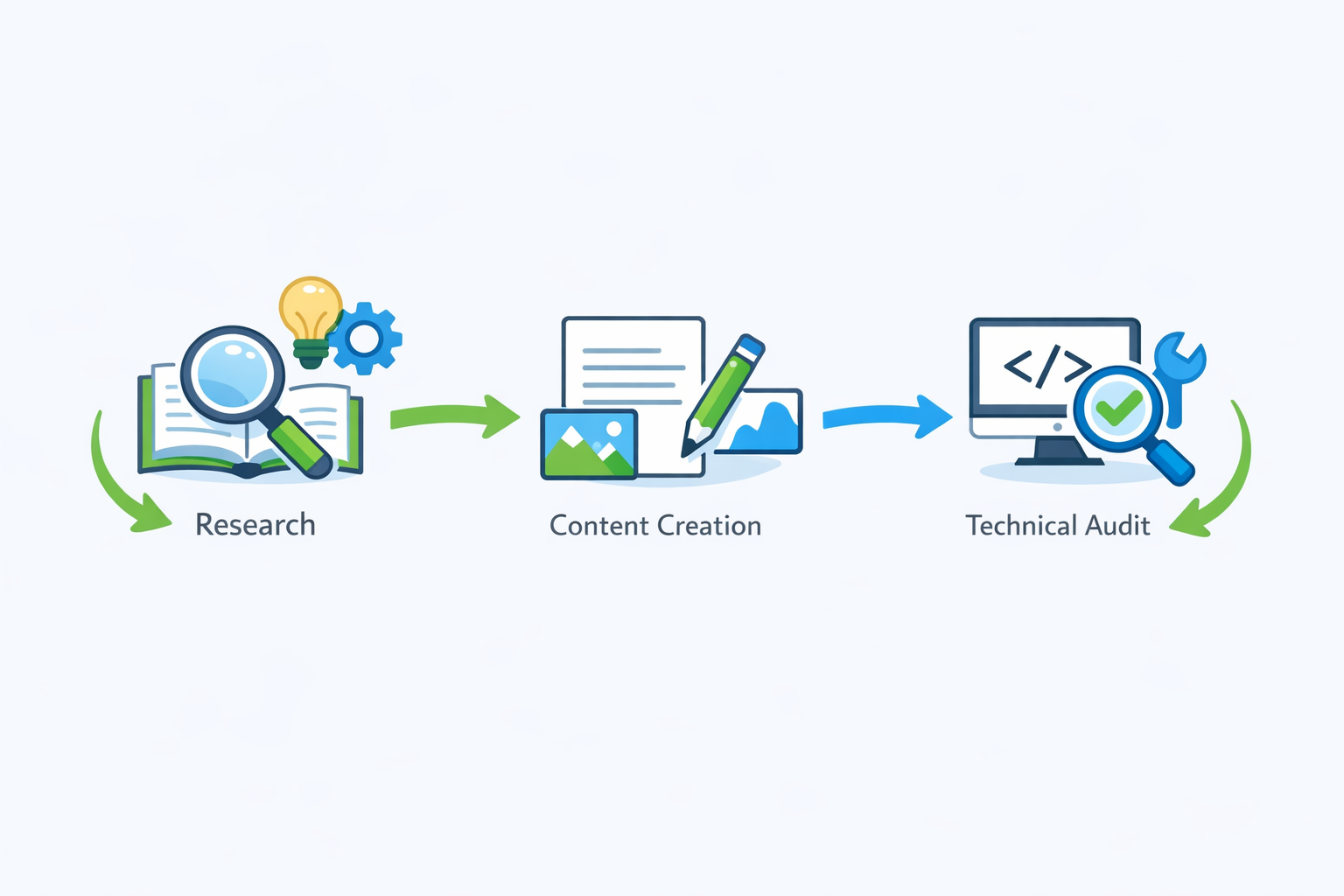
Start with research. If your team spends hours on keyword clustering and topic mapping, that’s a clear candidate for automation. Tools like our AI Keyword Researcher can generate cluster maps and competitive insights in a fraction of the time. Same with the Topic Authority Builder, which helps you map out content clusters that strengthen topical authority across your site.
Move to content creation. AI won’t write your best content for you, but it can handle the scaffolding. The key is effective prompt engineering—the quality of your prompts directly determines the quality of your outputs. Generating meta descriptions, for example, is tedious work that doesn’t require deep strategic thinking. Our Meta Description Generator can produce click-worthy options in seconds, freeing your team to focus on the content itself. For a comprehensive content strategy framework, see our Content Marketing Playbook.
Don’t skip technical foundations. Even the best content won’t rank if your site has crawlability issues or performance problems. Regular audits catch problems before they compound. The Website Audit tool analyzes SEO health, page speed, and technical issues, then translates findings into recommendations you can actually act on. According to Google’s own documentation, technical accessibility remains a foundational ranking factor.
The New Optimization Layer: AI Search Engines
Here’s what a lot of SEO strategies are missing in 2026: optimization for AI-powered search platforms.
ChatGPT, Claude, Perplexity. These tools are answering questions that used to go to Google. And while their market share is still small compared to traditional search, the users they attract tend to be high-intent researchers, early adopters, and decision-makers.

The good news is that AI search optimization shares DNA with traditional SEO. Clear content structure, authoritative sources, accessible technical setup. But there are specific signals these platforms look for that most sites aren’t addressing. We cover this extensively in our GEO Guide.
One emerging standard is the llms.txt file, a way to help AI systems understand your business, services, and content structure. Think of it like robots.txt, but for language models. Our LLMs.txt Generator creates this file based on your site information, making it easier for AI platforms to accurately represent your brand. Learn more about this in our post on what an llms.txt file is and how to optimize it.
Want to know where you stand? The AI Search Optimizer checks how well your site is set up for AI search engines like ChatGPT, Claude, and Perplexity. It’s a quick way to identify gaps before your competitors do.
Measuring What Matters
AI tools generate a lot of data. The challenge is knowing which metrics actually connect to business outcomes.
Traffic is obvious. Rankings matter. But the teams getting the most from AI-driven SEO are tracking efficiency metrics too. How long does keyword research take now versus six months ago? How many content pieces can you produce at the same quality level? What’s your time-to-publish for new pages?
These operational improvements compound over time. A team that produces optimized content twice as fast isn’t just more efficient. They’re capturing opportunities that slower competitors miss entirely. For more on tracking what matters, see our post on tracking and analyzing your campaigns.
For projecting the business impact of these changes, a tool like the ROI Calculator helps visualize returns across different campaign investments. It’s useful for internal planning and for making the case to stakeholders who want to see numbers.
The Competitive Reality
Your competitors are adopting AI tools. That’s not speculation; it’s already happening across the industry. The question isn’t whether to use AI for SEO. It’s whether you’re using it strategically or just adding complexity without results.

The winners in 2026 will be the teams that treat AI as an accelerant for sound strategy, not a replacement for it. They’ll use automation to handle repetitive tasks, freeing human attention for the creative and strategic work that actually differentiates brands. As Search Engine Journal reports, the integration of AI into search is accelerating, making preparation essential.
The fundamentals haven’t changed. What’s changed is how fast you can execute on them.
Related Reading
- AI-Powered Content Prompt Generation: Boost Your Content Strategy
- A Practical Guide to Optimizing for AI Search
- GEO vs. SEO: Why Your ‘Keyword First’ Strategy is Failing
- Why AI Citations Matter More Than Keywords in 2026
- Free AI Marketing Tools to Supercharge Your SEO Strategy
Ready to accelerate your SEO with AI-powered tools? Explore our free tools or get in touch to discuss your strategy.