Why Content Pruning Beats Content Volume In AI Search
AI search rewards clearer, tighter pages. Here is why pruning, consolidation, and stronger proof now beat publishing more average content for SEO teams.
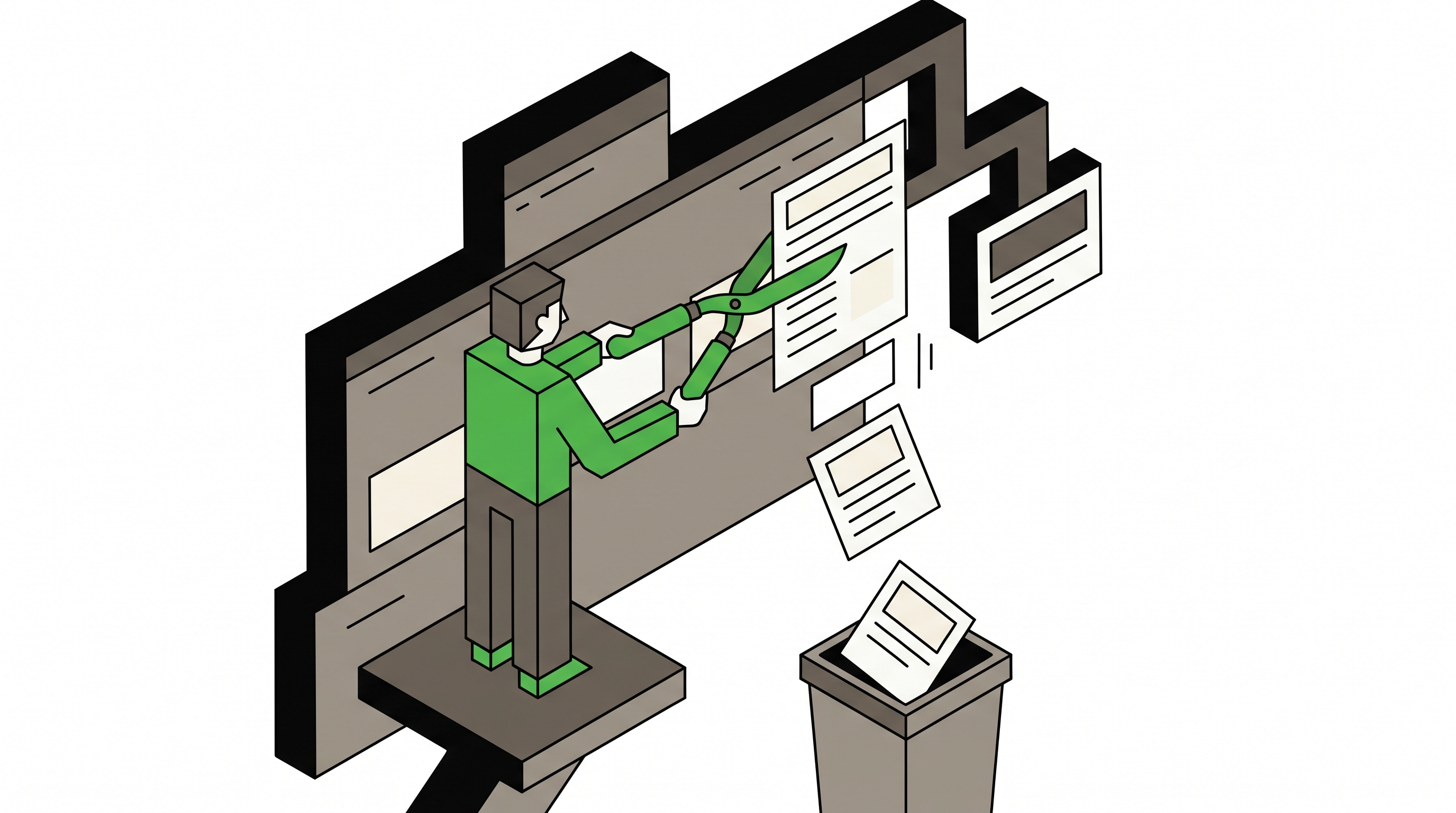
Content pruning beats content volume in AI search because retrieval systems reward the clearest page, not the biggest archive.
That shift got much harder to ignore this past week. On June 18, 2026, Search Engine Land published a detailed guide to content pruning for AI search, arguing that older SEO libraries often create clutter that weakens relevance, authority, and retrieval. One day earlier, Search Engine Land reported that AI systems like Gemini may only use about 380 words from a webpage for grounding, and that pages under 5,000 characters showed a 66% extraction rate while pages over 20,000 characters dropped to 12%.
That is the real story. AI search does not reward who published the most. It rewards who made the answer easiest to extract, trust, and cite.
If your site has ten thin posts that all circle the same question, AI does not see ten assets. It often sees one blurry signal. If you merge the overlap, tighten the answer, remove filler, and add proof, you give both search engines and AI systems a better source.
For marketers, agencies, and local businesses, that changes the weekly content conversation. The fastest win is often not another new blog post. It is deciding what to delete, what to merge, and what deserves a full rewrite.
AI Search Has Turned Content Bloat Into A Visibility Problem
Traditional SEO could tolerate some mess.
A bloated site could still rank if the domain had authority, the internal linking was decent, and the query was soft enough. A weak article might win a few clicks simply because it matched the keyword and had less competition than it deserved.
AI search is less forgiving. When a system has to synthesize an answer, it does not care that your site published three related posts in 2023, four more in 2024, and a slightly refreshed version last quarter. It cares whether one page gives it a clean, supportable answer now.
This is part of why the numbers from the latest Fractl and Search Engine Land study matter so much. The study, published June 17, 2026, found that 70% of consumers say they are using AI tools for search more than last year. But the share who see AI search as more helpful than traditional search fell from 82% a year ago to 54%, while the skeptic segment grew from 3% to 17%.
Usage is up. Trust is harder to win.
That is why content bloat is more dangerous now than it was even six months ago. When AI users are already skeptical, a vague answer, an outdated page, or a redundant article does not just fail to impress. It raises doubt.
Pew Research’s June 17, 2026 Americans and AI 2026 report adds more context. Pew found that 49% of U.S. adults now use AI chatbots, up from 33% in 2024, and 24% use them daily. This is no longer edge behavior. It is mainstream information behavior.
When half the market is comfortable asking AI for answers, the quality of your source pages becomes a front-line marketing issue.
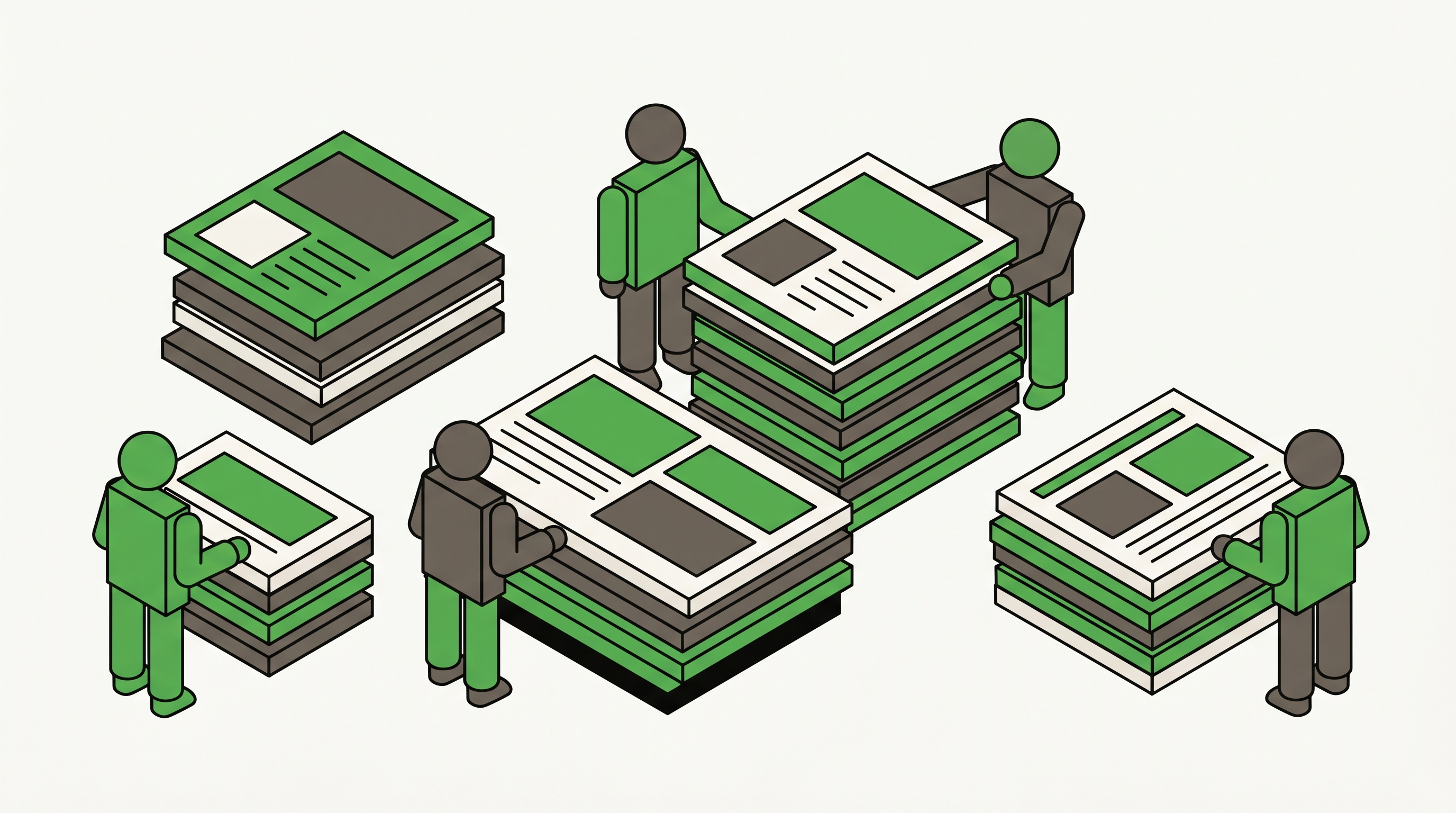
More Pages Often Means Weaker Signals
A lot of sites are carrying content debt that made sense in an older publishing model.
They have:
- multiple posts answering nearly the same question
- service pages that compete with supporting blog posts
- outdated “ultimate guides” padded to hit a word count
- FAQ pages with generic copy and no evidence
- local pages with only minor keyword swaps
None of that helps AI systems understand which page is the best source. It usually fragments authority across similar URLs.
The June 17 Search Engine Land piece on the decline of the ultimate guide made this point in a more technical way. If extraction is constrained, then long pages that bury the answer become harder to use. The issue is not that every long page is bad. The issue is that length by itself no longer signals depth, and in many cases it actively hides the strongest material.
That is the opposite of what most content calendars were built to do.
A publishing-first strategy asks, “What else can we add?”
A pruning-first strategy asks, “What is competing with our best answer?”
That second question is more valuable in 2026.
This also lines up with the newest measurement layer entering the market. On June 18, 2026, Search Engine Land covered Adobe Brand Visibility, a new platform built on nearly 300 million real-world AI search prompts. Adobe also cited growth in AI traffic to U.S. retail sites of 1,324% and travel traffic growth of 2,215% between October 2024 and May 2026. Marketers are finally getting tools to see where they win or lose in AI search, and those tools will expose duplicate, weak, and confusing content faster than old rank reports ever could.
If a brand now has prompt-level visibility data, then a messy content library stops being an invisible problem.
What To Prune, What To Merge, And What To Keep
Pruning does not mean deleting pages just to make the content inventory smaller.
It means making hard decisions about page purpose.
Here is the framework that matters most:
Remove Pages That Add No Unique Value
If a page has no traffic, no links, no conversions, no citations, and no distinctive information, it is a cleanup candidate.
Some pages exist only because a team needed to hit a publishing cadence. If nobody would miss the page and it does not strengthen another asset, it is probably dead weight.
Merge Pages That Compete With Each Other
This is often the biggest win.
If you have three posts on closely related questions, one decent FAQ, and a weak service page section all targeting the same buyer concern, combine the best parts into one stronger asset. Then redirect the leftovers.
That gives the surviving page a better chance to rank, a better chance to be cited, and a better chance to convert.
Rewrite Pages That Still Have Strategic Value
Some pages should stay live, but not in their current state. A page might have rankings, backlinks, or brand relevance, but still be too soft for AI retrieval.
Those pages need:
- a direct answer near the top
- fewer repeated sections
- stronger sourcing
- more specific claims
- clearer formatting
- tighter alignment with the actual question the page is supposed to answer
What content gets cited by AI and what gets ignored is a more useful standard than old blog cadence metrics.
Keep Pages That Own A Clear Job
A page should stay when it has a distinct role in the site architecture. That could mean a revenue page, a comparison page, a proof page, a location page, or a truly useful educational asset that answers a separate question from everything around it.
The key is that each page should earn its slot.
Why This Matters For Local Businesses And High-Intent Service Brands
This is not just a publisher problem. It hits local businesses and service brands hard.
Roofers, treatment centers, law firms, clinics, manufacturers, and agencies often build content libraries full of overlapping “tips,” “signs,” and “best practices” posts while their revenue pages stay thin. That was already inefficient. In AI search, it gets worse because the answer layer often pulls from the clearest source, not the most prolific one.
At Emarketed, we have seen the upside of a cleaner authority system with LA Roofing Materials. The brand grew from near-zero organic presence to 2,000+ keyword rankings and a 258% surge in AI mentions. That kind of growth does not come from publishing random blog volume. It comes from steady work on page quality, relevance, and supporting trust signals over time.
For local brands, pruning usually reveals a simple truth: the site has too many supporting articles and not enough strong answer assets tied to actual buying intent.
That is why our earlier post on local service SEO answer pages is still the right next read for service businesses. Before adding another blog post, get the high-intent answers right.

How To Measure Whether Pruning Is Working
Many teams stall here. They know the library is bloated, but they do not know how to prove the cleanup is helping.
Google gave marketers a better starting point on June 3, 2026, when it announced dedicated Search Console performance reports for generative AI features. The new reporting includes impressions, pages, countries, devices, and dates tied to AI features in Search and Discover for sites included in the rollout.
That matters because content cleanup should now be tied to more than rankings and sessions. After pruning or consolidation, watch for:
- stronger impressions on the surviving page in AI search reporting
- fewer internal competitors around the same intent
- better engagement on consolidated assets
- more consistent branded descriptions across search surfaces
- improved assisted conversion behavior on pages that were rewritten
This is also where a proper SEO service strategy starts to overlap with AEO work. The same cleanup that helps a page rank more cleanly can help it become easier for AI systems to summarize accurately.
The trap is expecting instant volume spikes. Pruning is often a quality play before it becomes a traffic play. In many cases, the first sign of progress is cleaner page ownership, not a dramatic chart jump.
That is still a win.
A Monday Morning Pruning Plan
If your site feels overloaded, start small and stay blunt.
Pull a list of pages that touch the same topic cluster. Then review them with five questions:
- Which page is the best answer for the main question?
- Which pages are mostly repeating that answer?
- Which pages have proof, links, or authority worth preserving?
- Which pages only exist because of an old publishing calendar?
- Which page should become the canonical asset after consolidation?
After that, work in this order:
- Merge overlapping informational posts into the strongest surviving URL.
- Tighten the surviving page so the answer appears early and clearly.
- Add real sources inline and remove filler sections.
- Redirect the weaker duplicates.
- Track the consolidated page in both classic search reporting and AI visibility reporting.
Teams that do this well are not shrinking their strategy. They are concentrating it.
That is the practical shift AI search is forcing on the market. Content operations are moving away from maximum output and toward maximum clarity.
The Smart Play Is A Smaller, Sharper Library
The old logic said more coverage created more opportunities.
In AI search, more overlap often creates more confusion.
That is why content pruning beats content volume in AI search. It gives your best pages more room to win. It reduces internal competition. It improves extraction. It makes citation easier. It usually makes conversion paths cleaner too.
The brands that adapt fastest will not be the ones bragging about how many posts they shipped this quarter. They will be the ones whose pages are easiest to retrieve, easiest to verify, and hardest to replace.
If your site is carrying a backlog of overlapping pages, that is not a reason to panic. It is a reason to edit with intent. Fix the duplicates. Merge the near-misses. Rewrite the pages that deserve to survive. Then measure the cleaner signal you created.

FAQ
What Is Content Pruning In AI Search?
Content pruning is the process of removing, merging, redirecting, or rewriting pages so your site has fewer weak or duplicative assets and stronger pages for AI systems to retrieve and cite.
Does Pruning Mean Deleting Old Blog Posts?
Sometimes, but not always. The better move may be consolidation or a full rewrite if the page still has links, rankings, or useful information worth keeping.
Why Does Content Volume Hurt AI Visibility?
Because multiple weak pages can split authority and make it harder for AI systems to identify the clearest source. More pages do not automatically create more trust.
How Do I Choose Which Page Should Survive A Consolidation?
Keep the page with the strongest mix of relevance, backlinks, rankings, conversions, and clarity. Then move the best information from overlapping pages into that asset and redirect the rest.
What Should I Measure After A Pruning Project?
Watch rankings and traffic, but also monitor AI search impressions, citation visibility, on-page engagement, and conversion behavior on the surviving pages.