AI Search Is Splitting in Two, and Agencies Need a Different Strategy for Each
Google is building ads into AI search while Perplexity is betting on premium trust. Here is what that split means for SEO, AEO, paid media, and agency planning in 2026.
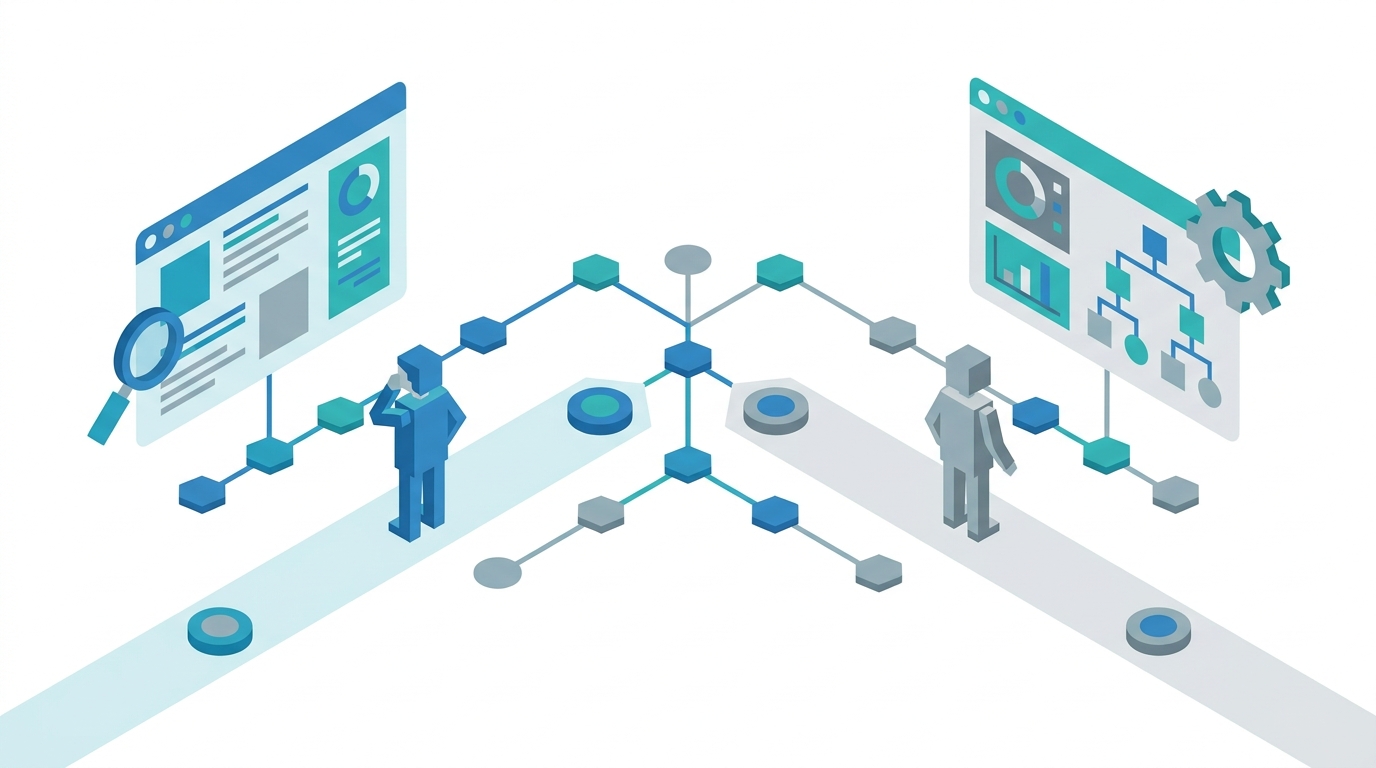
AI search is not becoming one market. It is splitting into two.
On one side, Google is rebuilding search economics around AI answers, ads, and a familiar advertiser model. Search Engine Land argued this week that AI Mode is already shaping up as Google’s next ads engine, and Digital Applied reported that ads now appear in 25.5% of AI-generated results, up 394%, while AI Overviews show up on 48% of queries. On the other side, Benzinga reported that Perplexity is signaling a different bet: monetize high-intent users directly, not the query with ads.
That split matters more than another generic headline about AI changing search.
It means agencies cannot plan AI visibility as one channel anymore. The rules for winning in an ad-heavy AI environment are different from the rules for winning in a trust-heavy one. If your team treats ChatGPT, Google AI Mode, Perplexity, and AI Overviews like interchangeable surfaces, you will misread where your brand is visible, how buyers are making decisions, and what to fix first.
The real shift is economic, not just technical
A lot of AI search coverage gets stuck on interfaces. Which product has better answers, better citations, or more users. That matters, but it misses the bigger point.
The more important question is how each platform plans to make money, because monetization shapes the user experience marketers actually have to operate inside.
Google knows how to make money from search. It has advertiser demand, reporting infrastructure, bidding behavior, agency workflows, and decades of muscle memory. So it is doing the logical thing: pulling AI answers into the same machine. According to Digital Applied, AI Mode reached 75 million daily users, and ads are now visible in roughly a quarter of AI results. That is not a side experiment. That is a signal.
Perplexity is pointing in a different direction. As Benzinga wrote, Perplexity’s pitch is that some users care enough about accurate, high-stakes answers to pay for a cleaner experience. Less ad inventory, more premium intent.
Those are not small product choices. They create two different search environments.
One environment is optimized to preserve advertiser economics while blending paid and organic influence inside AI answers. The other is trying to protect trust and monetize the user relationship itself.
For marketers, that changes everything from content structure to reporting.
Why this split changes agency strategy right now
Most agencies still organize AI search in a way that feels convenient internally and wrong externally.
SEO owns rankings. Paid owns budget. Content owns production. Analytics owns dashboards. Then everyone meets once a month and wonders why AI visibility is hard to explain.
That structure was shaky even before conversational search. It gets worse when a user sees one synthesized answer, a small citation set, and sometimes a sponsored layer around it.
In Google’s AI surfaces, visibility is heading toward a blended model. A brand can be cited in the answer, appear under the answer, run adjacent paid inventory, or disappear completely. In Perplexity’s world, where trust is a bigger part of the product promise, authority and citation-worthiness do more of the work.
That means the old channel split no longer maps cleanly to the buyer’s experience.
The better planning model is query ownership.
For each important query cluster, your team should know:
- Whether the brand appears in the AI answer.
- How the brand is framed if it appears.
- Which publishers or competitors are getting cited instead.
- Whether paid inventory exists or is likely to matter on that surface.
- Whether that query belongs in a trust-first play, an ad-supported play, or both.
If you do not know those five things, you are not managing AI search. You are just producing assets and hoping a dashboard will explain it later.
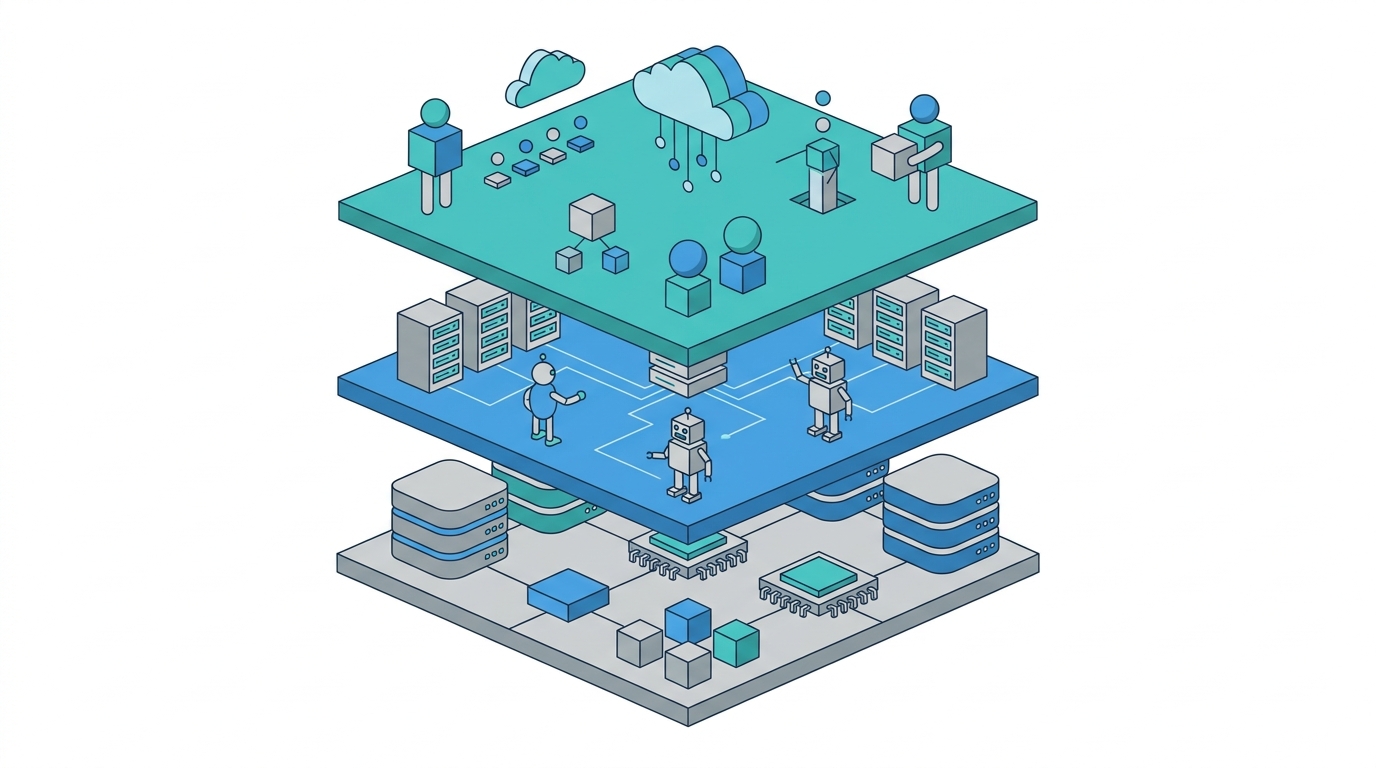
Google’s path rewards integrated organic and paid planning
Google’s version of AI search is the easier one for agencies to understand because it still rhymes with the past.
There is still a massive search habit. There is still a mature ad platform. There is still a familiar incentive to keep users in the interface while monetizing commercial intent. The surface is different, but the business logic is not.
That is why I think many teams will underestimate how fast Google’s AI surfaces become a planning problem for both SEO and paid media.
When AI Overviews appear on nearly half of queries, and when ads are increasingly present within AI-generated experiences, you cannot afford to keep AEO in one deck and paid search in another. They are shaping the same impression.
This is especially true for high-consideration categories. The AI summary sets the frame. The citations define trust. The paid unit may reinforce the shortlist, but it rarely creates the shortlist from scratch.
That has two practical consequences.
First, organic citation work becomes more important, not less, in ad-supported AI environments. If your brand is cited and then also shows up in paid placement, that is a powerful sequence. If your brand is absent from the answer and only present in the ad, you are buying attention without owning the narrative.
Second, paid teams need prompt-level intelligence from SEO and AEO teams. The prompts worth buying against are often the same prompts worth earning citations on. Treating those as separate workstreams means duplicating research and missing context.
We have seen this across client work. Seasons in Malibu holds 4,200+ keyword rankings, 814,230 monthly social impressions,, a full-service result covering SEO, AEO, paid search, social, and web. That result matters here because AI-era visibility compounds. No single channel carries the whole load anymore.
Perplexity’s path rewards source quality and decision-stage authority
Perplexity is a different challenge.
If Google’s AI search path looks like an evolution of search advertising, Perplexity looks more like a test of whether trust can become the product.
That changes what brands need to do to win there. You are not planning around ad inventory first. You are planning around whether your content survives retrieval, earns citation placement, and sounds credible enough to be used in a high-intent answer.
That is why sloppy AI search strategy falls apart fast on Perplexity. Thin content clusters, vague brand pages, inflated claims, and generic comparison pages do not just underperform there. They often fail to enter the conversation at all.
A recent platform analysis from SEO Strategy makes the split even clearer. It says only 12% of cited sources overlap across ChatGPT, Perplexity, and Google AI for the same query. The same analysis also points to a 14.2% conversion rate for AI-referred traffic versus 2.8% for standard organic in one cited dataset. Even if you treat those numbers carefully, the directional point is hard to ignore: a citation from the right AI environment can be much more valuable than a casual organic click.
That is a different optimization problem than traditional SEO.
For Perplexity, content needs to be concrete, well-structured, source-backed, and unmistakably useful at the passage level. Comparison content needs actual comparisons. Service pages need clear proof. Industry pages need specifics, not recycled templates.
If your site sounds like it was written to rank rather than to inform, that weakness becomes more obvious in AI retrieval systems than it was in old-school blue-link search.
Healthcare, B2B, and local service brands should not use one AI playbook
This split matters across the board, but it is most urgent in categories where the user is not casually browsing.
Healthcare is the clearest example.
Patients are increasingly asking AI systems about symptoms, treatment options, provider types, insurance, and facility comparisons. At the same time, healthcare search is under heavier trust pressure than most industries. Google has already shown it will pull back or recalibrate AI experiences when accuracy becomes a liability, as we covered in our post on Google’s healthcare AI Overviews pullback.
That should not make healthcare marketers feel safer. It should make them more serious.
When search splits into an ad-supported path and a trust-supported path, healthcare brands cannot afford to rely on one tactic. They need the authority to get cited and the governance to protect brand accuracy wherever AI surfaces present them.
The same logic applies to B2B and local professional services, though for slightly different reasons.
In B2B, buyers often use AI for shortlist formation, vendor comparison, and problem framing before they ever fill out a form. In local services, AI answers can flatten the market by reducing a page of options to a tiny recommendation set. If your brand is not in that set, your website might as well be invisible for that moment.
This is where internal links should support, not distract. If you need a practical starting point for tightening answer readiness, our AEO services page breaks down what a real optimization program should cover. That is enough for one tools-or-service style link in this piece. The rest of the work needs to happen in the content itself.
What agencies should do this week
This trend is big, but the next steps are not complicated.
1. Separate platforms in your reporting
Stop using one broad AI visibility bucket.
Track Google AI Overviews, Google AI Mode behavior where observable, ChatGPT presence, and Perplexity citations separately. If only 12% of cited sources overlap across platforms, then combined reporting hides the actual problem.
2. Build a prompt library by decision stage
Not all prompts deserve the same treatment.
Split prompts into informational discovery, commercial comparison, local intent, reputation validation, and post-click conversion support. Then identify which platforms matter most for each stage.
A consumer healthcare query might need trust-first content for Perplexity and citation-ready medical clarity for Google. A B2B software comparison might need stronger review-site corroboration for ChatGPT and sharper comparison tables for Perplexity.
3. Review source quality on core pages
Look at the pages you expect AI systems to cite.
Do they answer the question in the first few lines? Do they use specific proof? Do they show expertise? Do they contradict other pages on your own site? Are they padded with filler written for yesterday’s SEO logic?
If the answer is yes to that last question, fix the page before you buy more media.
4. Stop treating traffic as the only success signal
Traffic still matters, but it no longer tells the whole story.
A brand can lose clicks and gain influence if it is consistently named in answers that shape buyer decisions. That does not mean traffic loss is good. It means reporting has to capture citation presence, competitive mentions, branded search lift, and assisted conversions alongside visits.
5. Decide where trust matters more than reach
This is the strategic call most teams skip.
Not every category needs the same platform emphasis. If your buyer is making a high-stakes decision, trust-heavy surfaces may deserve more attention than high-volume ones. If your model depends on scale and demand capture, ad-supported AI search may matter more.
The point is not to pick one side forever. It is to stop pretending all AI search surfaces reward the same behavior.
What most marketers are still getting wrong
The lazy version of AI search strategy says this: publish more structured content, add schema, and monitor mentions.
That is not enough anymore.
The smarter framing is that AI search now has different economic layers, and each layer changes what visibility is worth.
In an ad-supported layer, the goal is not just to be present. It is to be present in a way that makes paid support more efficient. In a trust-supported layer, the goal is to be reliable enough that the system wants to use you at all.
Those are connected goals, but they are not identical.
This is why some brands look strong in Google and weak in Perplexity. It is why some brands get cited in AI answers yet see weaker click-through than expected. It is why some agencies can show a client ranking gains while the client feels less visible in the market.
Visibility is fragmenting. Strategy has to catch up.
FAQ: AI search monetization and strategy
Is Google AI search now mainly a paid media game?
No. Paid presence is growing, but organic citation still shapes trust and framing. In Google’s AI environments, paid and organic influence each other. Treating it as only a media problem is a mistake.
Does Perplexity’s no-ad direction mean brands cannot influence visibility there?
Not at all. It means influence comes more from source quality, authority, and citation-worthiness than from buying placement. That can be harder, but it is often more durable.
Should agencies build separate strategies for each AI platform?
Yes, at least at the reporting and prompt-priority level. The overlap in cited sources is too low to assume one optimization plan will cover everything.
Which industries need to adapt first?
Healthcare, B2B services, legal, finance, and local professional services should move quickly because trust and shortlist formation matter so much in those categories.
What metric should replace rankings?
Nothing replaces rankings entirely, but they need company. Track citation presence, competitive mention share, branded search lift, assisted conversions, and prompt-level visibility by platform.
What should a marketing team do first?
Audit your top query clusters across Google AI surfaces, ChatGPT, and Perplexity. Then map which pages deserve trust-first improvement and which queries deserve integrated organic and paid planning.
What to do Monday morning
Pull your top 25 high-intent prompts and test them across Google AI Overviews, Google AI Mode, ChatGPT, and Perplexity.
Do not ask only, “Do we rank?” Ask: are we cited, how are we described, who keeps showing up instead of us, and which of these environments is becoming paid versus trust-led?
That exercise will tell you more about your 2026 search exposure than another month of traffic reporting alone.
AI search is not consolidating into one system. It is splitting into different economic models with different rules. The agencies that win will be the ones that plan for both.