AAIO: Why Your Website Needs to Speak to AI Agents, Not Just Humans
Agentic AI Optimization (AAIO) is the next evolution after SEO, AEO, and GEO. Here's what agencies need to build now before AI agents route around your site entirely.
Your website has always had one audience: humans. That’s over. As of late 2025, your site has two audiences, and the second one doesn’t read, doesn’t scroll, and won’t wait for your page to load. It either gets the data it needs or it moves on to a competitor who gave it what it needed.
That second audience is AI agents. And optimizing for them has a name: Agentic AI Optimization, or AAIO.
Search Engine Journal published a breakdown of this shift just this week, calling it “the most significant transformation since the internet began.” That’s not hyperbole. This is the shift that makes mobile optimization look like a footnote.
Here’s what AAIO means, why it’s different from everything that came before it, and what your agency or business needs to do about it right now.
The Alphabet Soup Problem: SEO, AEO, GEO, and Now AAIO
Every time search changes, a new acronym appears. Agencies get skeptical. Clients tune out. But tracking these terms matters because each one marks a real shift in how the web works.
SEO (Search Engine Optimization) was about ranking on Google. Keywords, backlinks, crawlability. You showed up when someone searched. Success meant page one.
AEO (Answer Engine Optimization) emerged when AI started answering questions directly. Google’s AI Overviews, ChatGPT, Perplexity. The game shifted from ranking to being cited. With AI search queries surging 527% year-over-year, AEO went from optional to essential almost overnight.
GEO (Generative Engine Optimization) expanded on AEO. Systems like ChatGPT and Claude don’t just cite one source; they synthesize information from dozens of sources into a single response. GEO means your content gets woven into those answers even when you’re not the primary citation. According to Frase.io, 65% of Google searches now end without a click to any website. GEO is how you stay relevant in that environment.
AAIO (Agentic AI Optimization) is different from all three. It’s not about being found or cited. It’s about being usable. A research paper from April 2025 by Luciano Floridi and colleagues defines AAIO as explicitly optimizing content for autonomous artificial agents that “initiate digital interactions independently.” In plain terms: AI agents are visiting your website to complete tasks, not just read content.
That distinction changes everything.
What Actually Changed in December 2025
The shift to agentic search didn’t happen gradually. It accelerated sharply at the end of 2025.
Google’s “Project Mariner” gave AI agents the ability to browse the web, fill out forms, and complete multi-step tasks on behalf of users. OpenAI’s “Operator” launched with similar capabilities. Anthropic expanded Claude’s computer use. All of this happened within a few months.
The result: AI systems are now doing things on your website, not just reading it. A user might ask an AI assistant to “find me a behavioral health facility in LA that accepts Anthem and has immediate availability.” The agent doesn’t ask the user to go search. It goes to your website, attempts to extract that information, and either succeeds or tries another facility.
As Search Engine Journal describes it: “If your site breaks when an agent tries to interact with it, you lose the business to competitors whose websites work.”
That’s the AAIO threat in one sentence.
Three Levels Where AAIO Matters
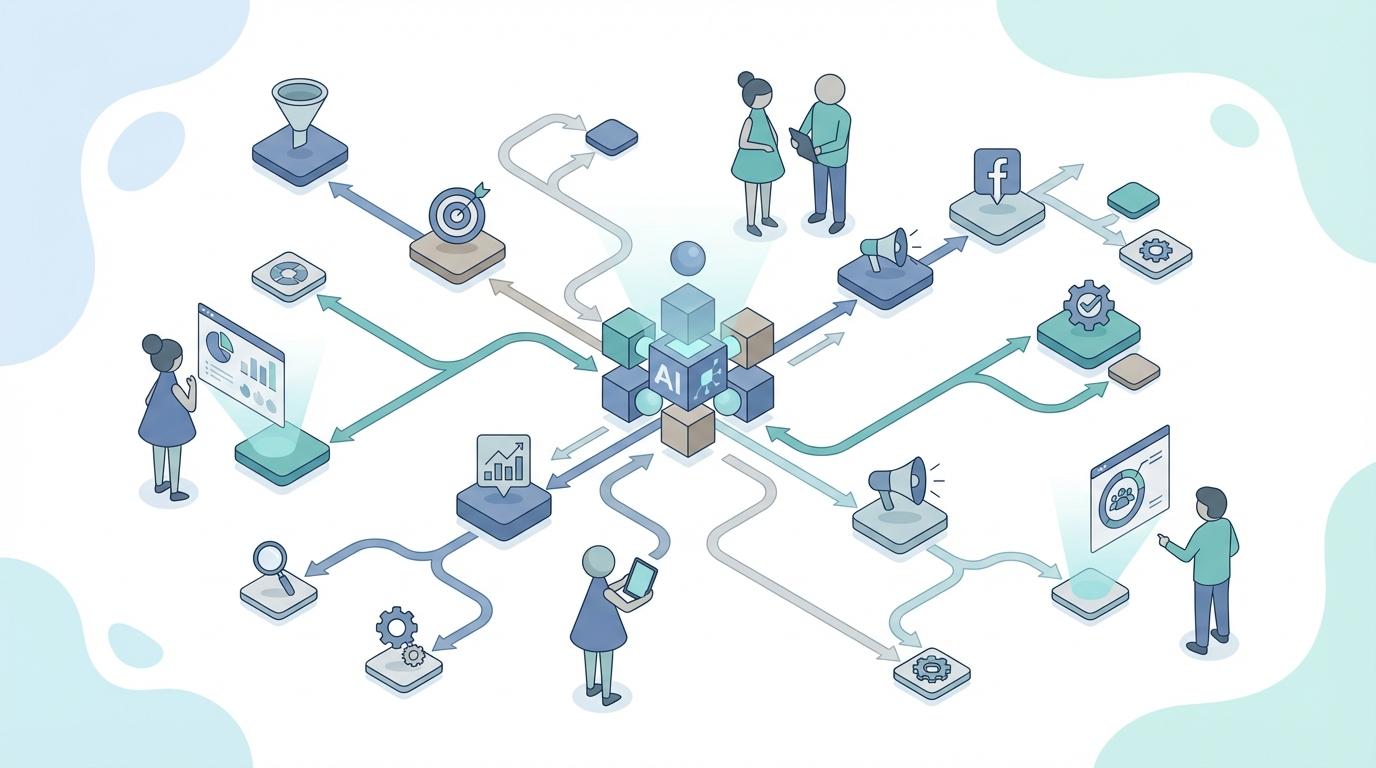
SEJ’s framework breaks agentic optimization into three levels. Each level has its own failure mode.
Level 1: Discovery
Can an AI agent find your content at all? This is still about structured data, schema markup, and clean crawlability. Agents use search engines and direct URL access. If your technical SEO is broken, agents can’t find you. This is the foundation.
Failure here means invisibility. Not lower rankings. Invisibility.
Level 2: Citation and Extraction
Can an agent extract the specific information it needs? This is where most websites fail in 2026. Your content might exist and be discoverable, but if pricing is hidden behind a form, if your service descriptions are vague marketing copy rather than specific facts, if your FAQ section requires JavaScript to expand, an agent will either misquote you or skip you.
Agents need clean, extractable, factual content. Not “we offer comprehensive behavioral health solutions tailored to your needs.” Give them: treatment types, insurance accepted, beds available, location, accreditations, contact method. Structured data helps. Direct, specific language helps more.
Level 3: Interaction and Action
Can an agent complete a task on your site? Book a consultation? Get a price? Submit an inquiry? This is the frontier. Agents increasingly need to transact, not just research. If your booking form only works with mouse input, if your chatbot requires a logged-in account, if your pricing requires a phone call, you are invisible at the action layer.
This level matters most for service businesses and healthcare facilities. A patient asking an AI assistant to “book me a consultation with a therapist near me” is not going to call twelve places. The agent will call one: the place whose site let it complete the task.
What Healthcare Facilities Must Do Right Now
Healthcare is the highest-stakes vertical for AAIO. When someone asks an AI agent about treatment options, rehab centers, or behavioral health services, that query often comes at a moment of crisis. It needs a fast, accurate, actionable answer.
Most healthcare websites are not optimized for this. They are designed for humans who browse, compare, and call. Agents don’t browse. They extract.
Here’s what healthcare facilities need:
Explicit insurance and payment information. Not “we work with most major insurers.” An agent needs: “We accept Anthem, Aetna, Cigna, and Blue Shield. We offer self-pay rates starting at $X per day.” That’s what gets extracted. That’s what gets cited.
Bed availability signals. Even a general statement like “we maintain availability for urgent admissions with 24-hour intake” gives an agent something to work with. Silence on this question means the agent will recommend a facility that answered it.
Structured schema markup for healthcare. Use MedicalOrganization schema, HealthAspect entities, and FAQPage schema throughout your site. These aren’t optional anymore. They’re how agents read you.
A fast, low-friction contact path. If the only way to reach your facility is a form that takes 3 minutes to fill out, agents will either fail or give up. A phone number, a booking link, or a direct chat option is what agents can hand off to users effectively.
For behavioral health facilities especially, Perplexity Health has already begun serving AI-generated answers for healthcare queries. If your facility isn’t in those answers, you’re not in the patient’s consideration set.

What Agencies Need to Build for Clients in Q2 2026
For digital marketing agencies, AAIO creates a new service line and a new client conversation. Most clients are not thinking about this. Most agencies aren’t either. That gap is the opportunity.
Here’s the audit checklist agencies should be running right now:
Technical readiness
- Is the site’s structured data current and comprehensive?
- Does the site load cleanly for non-JavaScript environments? (Many agents don’t execute JS)
- Is the robots.txt not accidentally blocking AI crawlers like GPTBot, ClaudeBot, or PerplexityBot?
Content extractability
- Are key facts (pricing, location, services, insurance, credentials) stated clearly and explicitly?
- Does the FAQ section use proper FAQPage schema?
- Is content organized around specific questions agents are likely to ask?
Action path optimization
- Can a user complete the primary conversion action (book, call, get a quote) in fewer than three steps?
- Is contact information structured and machine-readable?
- Are there clear, actionable next steps after every major content section?
AI discoverability
- Is there an llms.txt file in the root directory? (The new standard for telling AI systems how to use your content)
- Are there clear, authoritative pages for every major topic the business wants to be cited for?
- Is the site being monitored for mentions in ChatGPT, Perplexity, and Google AI Overviews?
Tools like our AI Search Optimizer can help you identify gaps in your current AI visibility and prioritize which fixes will move the needle fastest for your clients.
The Competitive Reality: You Have 6 Months
The agencies that figure out AAIO audits and implementations in the next six months will own that category. The same thing happened with mobile optimization in 2013 and AEO in 2024. Early movers build the case studies, the pricing benchmarks, and the playbooks. Everyone else catches up later at a lower margin.
This isn’t about replacing your existing SEO or AEO work. AAIO builds on both. A site that isn’t crawlable fails at the discovery layer before any of the higher-level agentic optimization matters. The stack is additive: SEO foundation, AEO citation layer, GEO synthesis layer, AAIO interaction layer.
What changes is the priority. In 2024, a site with great content and decent technical SEO could still win in AI search. In 2026, a site that can’t serve an AI agent trying to complete a task on behalf of a user will lose business in ways that never show up in a rank tracker.
FAQ
What is AAIO? AAIO stands for Agentic AI Optimization. It’s the practice of optimizing websites and digital content so that AI agents, not just human users, can effectively discover, read, and interact with them. Unlike SEO or AEO, AAIO focuses on enabling AI systems to complete tasks autonomously on behalf of users.
How is AAIO different from AEO? AEO focuses on getting your content cited in AI-generated answers. AAIO goes further: it ensures that AI agents can interact with your website to complete tasks like booking, pricing inquiries, and contact. AEO is about being quoted. AAIO is about being usable.
Do I need to redo my entire website for AAIO? Not necessarily. Most AAIO improvements are additive: structured data enhancements, content clarity improvements, schema markup updates, and contact path simplification. A technical audit will identify which gaps matter most for your specific business and competitive environment.
What’s an llms.txt file and why does it matter for AAIO? An llms.txt file is placed in your website’s root directory to give AI systems structured instructions about how to use your content. It’s similar to robots.txt but designed for large language models and AI agents. It signals which content should be prioritized, how to attribute your information, and what actions are permitted.
Is AAIO relevant for small businesses and healthcare facilities? Yes. Healthcare facilities face some of the highest-stakes AAIO scenarios: patients using AI agents to find treatment options, insurance coverage, and availability. If your facility’s information isn’t structured for agents to extract and act on, you may not appear in AI-assisted patient searches at all.
When should agencies start offering AAIO services? Now. The agencies winning in 2026 and 2027 will be the ones that started building AAIO frameworks in Q1 and Q2 2026. The window to be an early mover is closing quickly.
What Comes After AAIO
The agentic web is not a destination; it’s a transition. The next stage, already visible in enterprise contexts, is AI commerce protocols: standardized APIs that let AI agents complete purchases, book services, and initiate contracts entirely on behalf of users without any human interaction at any step.
For agencies, this means client websites are evolving from content platforms into machine-readable business endpoints. The brand, the content, the trust signals all still matter. But they need to be legible to software, not just to humans.
The businesses that treat their digital presence as infrastructure for AI agents, not just as a storefront for browsing humans, will have a significant structural advantage as AI becomes the dominant interface for finding and purchasing services.
If you want to understand where your current site stands on the AAIO readiness spectrum, start with a technical and content audit. Talk to us about building an AEO strategy that includes the full stack: discovery, citation, synthesis, and action. The window to do this ahead of your competitors is still open. But it won’t be for long.